Showing posts with label Local Food. Show all posts

Monday, April 08, 2013

Can You Say Wacko Taco?

The shutters on the new Wacko Taco stand will get
unrolled for opening day on April 11th,
Whenever I write one of my less-serious food pieces, like the one that just ran in the City Paper on the Charleston RiverDogs new beer milkshakes, there's always one line that gets me chuckling out loud as I write it. Invariably, that particular line will get immediately stricken from the story by the editor, probably because no one on earth but me would find it funny.

Usually Stephanie Barna is the one who puts the knife in my most beloved wisecracks, but this past week it was managing editor Chris Haire, who was covering the humor-suppressing duties while Barna was out on vacation.

Here's the line as it ran in the paper:

The Nacho House got its walking papers during the off-season, and it's been replaced by Wacko Taco.

Here's how it read in the original draft I submitted:

The Nacho House got its walking papers during the off-season, and it’s been replaced by Wacko Taco, a new stand focused on tacos whose name no one is really sure how to pronounce.

Okay, you're probably not rolling on the floor laughing, either, and looking over it with a little distance, I can definitely see there's a little structural issue with that sentence so that it's not exactly clear if its the name of the stand or the tacos themselves that no one knows how to pronounce.

I meant the stand, of course. You might find it more amusing if you had been with me at the park and realized that no one working for the RiverDogs seems to have a clue how it's supposed to be pronounced. The name "Wacko Taco" looks perfectly reasonable in print, but try saying it out loud a few times yourself.

It's clearly not "Whack-oh Tock-Oh," which is painful to even utter. "Whock-oh Tock-Oh" rhymes but sounds silly. If you say "Whack-oh Tack-oh", you sound like a housewife from Minnesota.

Both of the RiverDogs food and beverage gurus, John Schumacher and Josh Shea, stumbled over it when I asked them how it's pronounced. After butchering a few attempts, they both ended up landing on "Whack-oh Tack-oh," which I supposed is how it will end up being called.

Oh well.


Saturday, July 30, 2011

Shrimp & Grits: The Irresistible Seductress

Shrimp & Grits: My Version
Man, is it almost August already?  The kids got out of school at the beginning of June and suddenly I looked up and here we are more than halfway through it.  I've been keeping busy with work, travel (including a great family vacation to the Mid-Atlantic that I keep meaning to post pictures from) . . . and then a little family illness fun to boot.

I've also kept myself busy working on the City Paper's Summer Dish issue (coming out any day now), which mostly involves eating my way across the city.  Plus, as a follow up to my review visit to the Red Drum, I caught up with chef/owner Ben Berryhill and got the scoop on his new restaurant Next Door, which you can read here.

One thing from my interview with Berryhill that didn't make the City Paper piece was his take on shrimp and grits, which is another installment in a drama I like to call "Shrimp and Grits, the Irresistible Seductress." It goes basically something like this:

Young (or not so young) chef moves to Charleston seeking opportunity in a flourishing restaurant scene.  A true artist and dedicated to his craft, he defiantly declares that while he WILL immerse himself in the traditional food culture of his new city but he will NEVER, EVER serve that beguiling, evil recipe . . . Shrimp and Grits!

After all, what could be more cliched and trite? Does this city really need one more restaurant serving shrimp and grits?  No, it does not! our hero declares, and boldly stakes out a unique, original, and acclaimed fine dining menu.

The years pass, and delicious fresh shrimp flow in from local waters and appear on the chef's plates, and he's dishing up delicious heirloom stone-ground grits, too.  And then there's that fantastic, smoky artisanal bacon or sausage sitting right there on the line, too . . . and eventually, the temptation just overcomes him and the shrimp and corn and bacon merge . . . and there, on the menu, is that one item that he swore would never darken the pass-window at his restaurant: the diabolical SHRIMP AND GRITS!!!

Sean Brock of McCrady's and Husk was one of the most vocal holdouts against our city's staple dish, but he caved several years back and has since produced a splendid version at McCrady's, complete with grits from heirloom Jimmy Red Corn that are blasted frozen by liquid nitrogen before grinding, molded into a disk with shrimp, and topped with shrimp stock gel, sea-like foam, and colorful herbs and flowers.  At Husk, his version is a little more rustic but still fantastic, studded sometimes with Benton's bacon and other times with Surry County sausage plus wood-roasted tomatoes, braised fennel, and even a braised pigs ear.

Ben Berryhill told me a similar story.  When he came to town in 2005 and opened the Red Drum, he  was fresh off a twelve-year stint at Cafe Annie, the acclaimed pioneer of high-end Southwestern cuisine  in Houston, Texas.  Berryhill's plan (which he executed flawlessly) was to take traditional Lowcountry ingredients and apply his chile- and wood-grilled Southwestern style to them.  And, he was adamant that he would NOT  serve those treacherous shrimp and grits.

Ah, but the flesh is weak.  A few years later, he confesses, he "broke down" and created his own "Low-Tex" version.   The "Low" is fresh Lowcountry shrimp and Anson Mills grits, while the "Tex" is the venison sausage from Broken Arrow Ranch in the Texas Hill Country and the chile beurre blanc served on top.  And, boy, are they good.

Let those among us without sin cast the first stone.  One can fully understand the impulse for chefs to steer clear of the over-exposed, cliched local "specialties".  But, they all come around soon or later, and for one simple reason: the flavors of shrimp and corn are perfect together, and when you toss in a little smoky meat, it's absolutely glorious.

(I, too, have fallen.  I captured my version of shrimp and grits here some time ago.)


Wednesday, March 30, 2011

Asparagus!

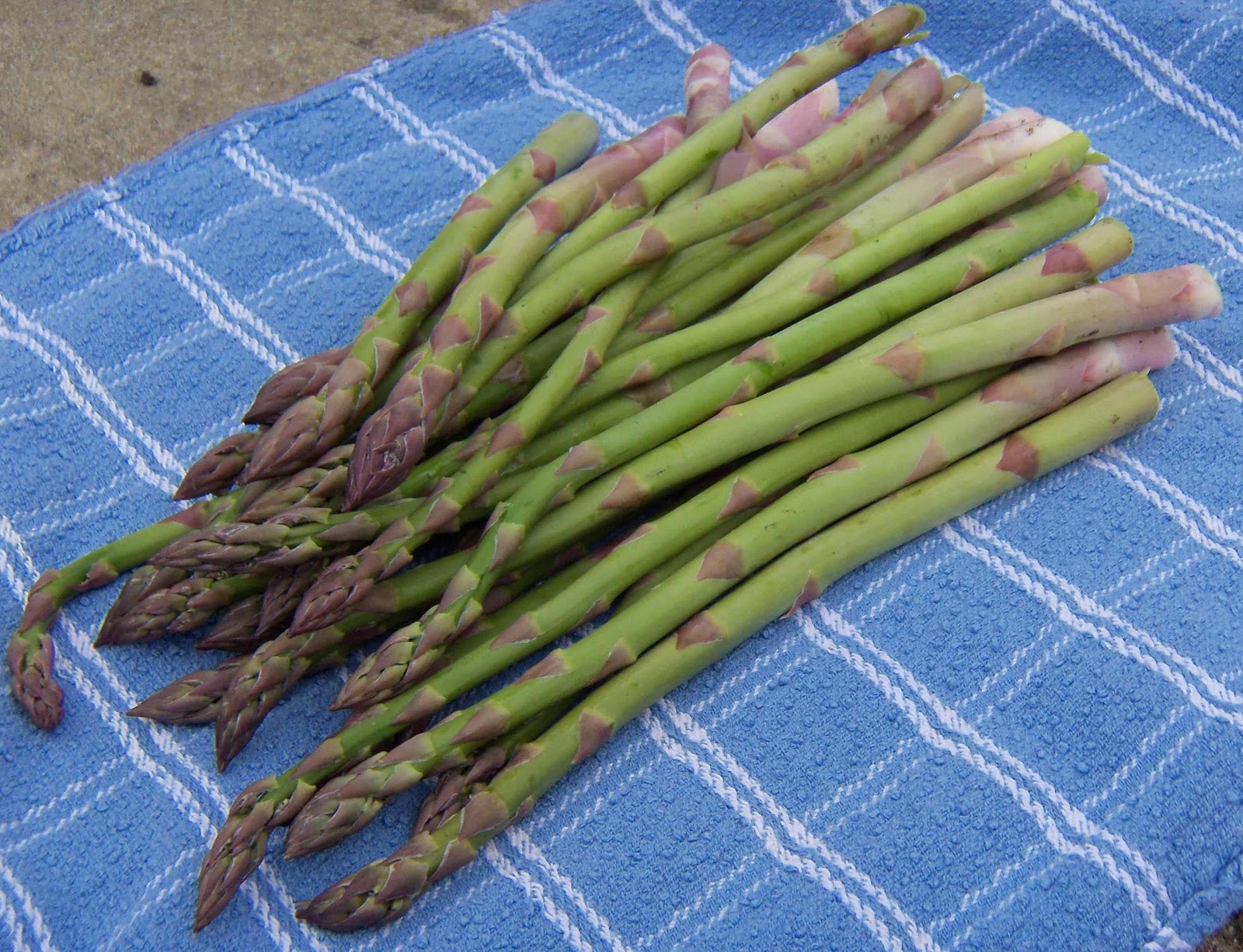
One of my favorite parts of spring is fresh asparagus.  Over the weekend I had some splendid local asparagus sprinkled with goat cheese from Jeremiah Bacon down at Oak.  The next day, I picked up a little of the new crop from Boone Hall Farms to make at home:


If the asparagus is in, that means strawberries can't be far behind.

Tuesday, December 21, 2010

All I Want for Christmas is a Sack of Meat

Last weekend my wife gave me my Christmas present early: an Artisan Meat Share from Craig Deihl of Cypress Restaurant.

We've already broken into the pork pate and the summer sausage, and both are terrific.  The pork pate includes, in addition to the obvious coarse-ground pork and spices, rich ingredients like pork liver, eggs, and cream plus onions and garlic, which result in what one might term one of the best meatloafs ever.

I'm even more enamored with the summer sausage.  It's a fermented, semi-dry sausage made from half beef and half pork, and it's blended with a whole bunch of spices that include black pepper, smoked paprika, mace, garlic, juniper, caraway, mustard, and marjoram.

Summer Sausage w/ a Selection of Cheese and Crackers


The fermentation not only helps preserve the sausage but also gives it a delightful tangy edge.  That and the slow smoking results in something that can only be described a deep and complex flavor.  The taste grows and expands as you hold it in your mouth, with very warm, smoky finish.  We've been eating it as simply as possible: sliced and served alongside cheese and crackers--and a dollop of pimento cheese, for good measure.

Also included in the bag is this line up: guanciale, lonza, saucisson sec, salami spread, country bologona, smoked turkey breast, and--if you can believe it--lamb bacon.  This last one is the most intriguing of them all.  It's cured with salt, brown sugar, and spices for 10 days and, the Meat Share's "User Guide" advises, should be eaten without cooking.

These should keep me busy over the Christmas holidays, and you can believe one or more of them will be turning up on the appetizer plates I'll be making for various holiday gatherings this week.

When in doubt, give the gift of meat.

P.S. Did I mention that my wife is the best Christmas gift buyer in the world?

Friday, November 12, 2010

In Search of the Infamous Charleston Waffle

I am hot on the trail of a lost South Carolina delicacy: the Charleston Waffle.  I'm not exactly sure what it is, but somewhere around 1910, the city of Charleston gained nationwide attention--and, not long afterward, notoriety--for its waffles.  In fact, the term "Charleston waffle" seems to have become synonymous with a rich, heavy breakfast dish.

The first mention I've found of the Charleston waffle is a short paragraph in the Montgomery Advertiser on November 25, 1910.  It reads, “The [Charleston] News and Courier is in favor of using the Charleston waffle to fix ships that leak. Sure, that's all they're fit for. The Charleston waffle, from what we can learn, is better for patching purposes than either asbestos or leather.”

That's a weird paragraph, but actually not all that unusual for 1910. That decade was the high era of the “paragraphers” in American newspapers, when a typical daily would devote several columns if not a whole page to corny one-paragraph jokes, some of them commentary on issues of the day, some snide remarks about paragraphs from other newspapers, and some just the kind of groaners your goofy great-uncle used to repeat at dinner parties. Things like: “A somersault is nothing to a hot-air artist.” And, “We don't imagine that the Missouri man sentenced by a judge to obey his wife for six months will notice any particular difference.” Some paragraphers even wrote paragraphs about paragraphers, like “A paragrapher has one consolation. He knows his children will never be annoyed by the inheritance tax.”

And, boy, did the paragraphers love the Charleston waffle. In March 1911, when President Taft rushed 10,000 troops to the Texas border as revolutionary violence swept through Mexico, the Charleston News and Courier reported that “the troops in Texas will be fed Charleston waffles every Sunday morning.” A paragrapher for the Philadelphia Inquired replied, “Probably one of the disciplinary measures of the camp,” and added for good measure, “Charleston, by the way, is somewhere on the coast of South Carolina.”

In fact, almost all of the documentary evidence I can find about the Charleston waffle is captured in various three-line cornball commentaries. Here are just a few of the dozens I turned up:

“One good thing about Charleston waffles in these days of high prices for food is that those that are served for breakfast necessitate so much chewing that they are about ready to swallow by the time the supper hour arrives.” - Charlotte Observer (December 26, 1911).
“We are convinced that the Chicago man in whose stomach the surgeons found nineteen pocket knives, seventeen nails, five knife blades, a dozen screws, and a silver dollar, could digest a Charleston waffle.” - Augusta Chronicle (September 11, 1912)
“Germany's death rate shows and increase. Have they started eating Charleston waffles over there?” - Columbia State (September 12, 1912)
“The pneumatic Charleston waffles are guaranteed against puncture.” - Columbia State (September 4, 1913)
“We wish to raise our voice in earnest protest against sending any Charleston waffles to Belgium.” - Columbia State (September 4, 1913)
Columbia's State newspaper was one of the most prolific abusers of the Charleston waffle—part, I am sure, of the long-standing rivalry between the South Carolina's old capital city and its new one. The State's editors, Robert Elliott Gonzales and Ambrose Elliott Gonzales, even captured in verse the following suggested punishments for Mexican revolutionary Pancho Villa:

Make him sing the Star Spangled Banner, or,
Become an umpire, or
Work in a munitions plant, or
Drink some blind tiger likker, or
Live in Charlotte, or
Read the Congressional Record, or
Eat a Charleston waffle, or
Appoint him a paragrapher.
I think that technically counts as verse since it has short lines and everyone of them sort of rhymes with the others.

The Charleston News & Courier, it seems, undertook a spirited defense of its hometown specialty in paragraphs of its own, though other newspapers invariably used these as opportunities to heap on more corn. In April 1911, for instance, the N&C wrote, “We sent a Charleston waffle to New York but, of course, some postal clerk could not stand the temptation, and he took it.” The Baltimore Sun reprinted the paragraph under the headline “Wanted to Mend a Tire, Maybe.” When the N&C claimed in February 1912 that, “A gentleman gained ten pounds in one week eating Charleston waffles,” the Philadelphia Inquirer shot back, “Either from mere indifference or neglect to inquire more closely into the affair, however, it does not give any information concerning the result of the inevitable surgical operation.”

But, wisecracks aside, what in the heck was the Charleston waffle? It was definitely more than just a paragraphers' joke.  In its restaurants section, the 1912 New Guide to Modern Charleston noted about Riddock's Arcade on King Street, “A specialty is the Charleston waffle, reknowned for its delicacy all over the country.”  I've as yet been stymied, however, to uncover exactly what made Charleston's version of the waffle so special and how it gained nationwide reknown.

Part of the horrified reaction to the city's waffle might have been related to the more widespread criticism of the richness of the Southern diet, which since the 1890s had been coming under fiercer and fiercer attack from the new movement of nutritionists and "domestic scientists."   A big theme of these folks around the turn of the 20th century was the idea of "hot" and "cold" foods and their proper diet for a particular climate.  Waffles fell into this bucket.  A reporter for the New York Sun, for example, visited the Cotton States Exposition in Atlanta in 1895 and recorded that, “the cold-bread eaters of the North and West” typically react “with horror of the richness of Southern cooking, their hot bread and waffles and their highly seasoned dishes.” Such food was thought to be at odds with the hot climate of the South and created, for whatever reason, “dyspepsia.”

But, most of the people making fun of the Charleston waffle were Southern newspapermen, ones I can only imagine had their fill of biscuits and cornbread on a regular basis.  So, the search goes on as I dig farther back into recipes and newspapers to see what I can dig up.  If anyone out there has any information that would help shed light on this mystery, please pass it along!

Saturday, November 06, 2010

Oh My Goodness . . .

In case you thought the KFC Double Down was something dramatic, here's the latest Extreme Stunt Food, as discovered by Janson Cumbie and Stephanie Barna out at the Coastal Carolina Fair.

Yes, it's just what the picture looks like: a cheeseburger made with two Krispy Kreme doughnuts as the bun.   Dubbed "The Luther", this, in my book, shoves the Double Down on the playground and rubs its face in the dirt.

Apparently, this monstrosity has been around for a few years, but, since I don't hang around too many State Fairs, it's a new one to me.  Check out it and all the other fair food  pics in the City Paper piece: they've got about thirty doozies that will either make you really really hungry or turn you into a vegetarian.

Thursday, July 01, 2010

End of an Era (for Retail, at Least)

The Moultrie News has a nice but wistful piece about the closing of Raul's Seafood, a Shem Creek institution.  Fortunately, the wholesale business will continue, so local restaurants will still have one of their main sources of fresh blue crab and fish.  But, for home cooks the seafood scene just got a little bit dimmer.

Sunday, May 16, 2010

Whole Hog. And I Mean It


A few months ago I wrote about hash and rice in a City Paper article on Lowcountry barbecue, in which I noted, "You don't need to ask too closely what goes into the pot to make hash, but suffice it to say it's an economical way to help use up most of a hog."  But thanks to mandatory food ingredient labeling, if you're really curious you can find out.

Here's a short list of the goodies from a variety from just up the road in Orangeburg:
pork head meat
pork hearts
pork (not exactly sure how the rest of this list isn't pork)
pork tongues
pork livers
pork ears
pork snouts
pork skins
I think that about runs the gamut.  On the non-pork ingredients, there's catsup, potatoes, onions, water, mustard, Worchestershire sauce, Molasses, soy sauce, and black pepper.

Now, just knowing the ingredients list isn't exactly the same as a recipe, but I pretty much bet the cooking instructions would read: "put all ingredients in a pot and boil for hours on end until everything is reduced to a smooth, consistent mush."

I just had hash and rice yesterday out at the Palmetto Chef in Summerville, and every time I have it I'm taken by how rich and smooth the slow-simmered pork concoction can be.  And you can't really even taste the pork snouts.


Wednesday, March 31, 2010

More Pickle Dog Scoop

Turns out there's more to the Pickle Dog story than meets the eye.  And, if demand is high enough, we may even see the Deep Fried Pickle Dog.

Details at Ben's Biz Blog.

Tuesday, March 30, 2010

Enter the Pickle Dog

My beloved Charleston Riverdogs just announced their new additions to their already splendid food offering at the Joe.   Their lineup of hot dogs is already legendary (as discussed in this City Paper piece), but they've added a few more for good measure.

A couple seem insignificant: the Beantown Dog (top-sliced lobster-roll style bun with baked beans) and the Yankee Dog (w/ brown mustard, sauerkraut, and chow-chow).  Okay, so we have a lot of imported Northerners bouncing around Charleston these days, but do we really need to make them feel more at home?  Who needs more options when you already have the legendary Riverdog with yellow mustard BBQ sauce and a slice of pickled okra atop?

But wait . . . there's the Pickle Dog.  If the description and photo from the Riverdogs' web site is to be trusted,  this is a hot dog that instead of a bun uses a big fat dill pickle--slice the pickle, slather on coleslaw, and stuff a hotdog inside.  Let me repeat: a hotdog stuffed inside a dill pickle!

Could be legendary.  Could be revolting.  April 8th I'll be lined up at the Doghouse concession stand to find out . . .

Sunday, November 08, 2009

Monday, June 15, 2009

Boone HALL Farms

Okay, just for the record since I think now a dozen out of towners have called me on this . . .

Boone Hall Farms is a historic Charleston plantation that has been converted to a large farming operation, and their ventures include a U-pick strawberry patch and a farm store that sells all sorts of great local produce plus fresh seafood, good cheese, and pretty darn good meats, too.

Boone's Farm is that rot gut swill that used to be fortified wine and now (due to some wrinkle in the tax law) is now a malt beverage but is still just as likely to make you puke when you guzzle a bottle of it while sitting on the hood of a car in some cul-de-sac or perhaps on a remote creek bridge at 2:00 am.

Just look for the "hall", okay?

Thursday, June 04, 2009

Grits: the Foundation of Southern Fusion Cuisine


Atlanta's SundayPaper.com has a good article on grits by Shane Touhy, the chef at Dogwood Restaurant and Charleston restaurant alumnus.

Touhy's description of Dogwood's "grits bar" illustrates grits' foundational role in what I call "Southern fusion"--that is, a variety of foods gathered from different subregions of the American South and rolled together into an upscale restaurant offering.

Dogwood's grits variations include (of course) the requisite shrimp-and-grits, and they bring in ingredients as diverse as Benton's country ham (Eastern Tennessee), Frogmore Stew (Lowcountry South Carolina), tasso (Cajun Country in Louisiana), an pimento cheese (which I think of as a Midlands South Carolina and Georgia specialty, but I'm not sure exactly where it originated.)

It's an appropriate role for grits, for what food could be more representative of how today's chefs have taken once-humble fare and elevated it to the realm of high cuisine?

Friday, May 29, 2009

Strawberry Basil Mojito


So, my visit to the Boone Hall U-Pick strawberry patch coincidend with a trip to the fabulous H&L Market in North Charleston, where I picked up a massive bag of basil for something like a dollar and seventy-five cents. That much basil seems destined for only one thing: a big batch of pesto. But, before then, I might as well use it to put a little dent in my strawberry stockpile.

This recipe is an attempt to recreate a splendid drink that I discovered for the first time out at The Lettered Olive on the Isle of Palms. It's a fine twist on the traditional mojito, and the strawberry and basil provide a nice sweet-minty interplay.

You make it pretty much the same way you would a mojito, but substitute basil for the mint and toss in 2 or 3 sliced strawberries. Just be sure you start with a proper mojito recipe!):

4 - 6 large, fresh basil leaves
2 - 3 strawberries, sliced
1 T sugar
3 T rum
Juice of 1 lime
2 T of club soda

Put the basil and sugar in a glass and muddle vigorously until the basil is starting to disintegrate and is melding into the sugar. Add the strawberries and mush with the muddle until blended with the basil and sugar. Put the mixture into a cocktail shaker and pour in the rum, lime juice, and club soda. Add ice, then shake until well blended. Pour into a rocks glass, Add ice and shake until well blended. Pour into a rocks glass, top with a splash of club soda, garnish with a lime, and enjoy.

Tuesday, May 26, 2009

Strawberries, Strawberries, Strawberries

I hit the Boone Hall Farm U-Pick strawberry patch over the weekend with The Eight-Year-Old, The Three-Year-Old, and The-Eight-Year-Old's-Friend. Three free jump castles are only part of the draw. We spent about ten minutes picking berries and those little fingers--even The Three-Year-Old's--are surprisingly nimble. I'd barely had time to turn around before we had four buckets groaning with fresh red berries.


I spent the rest of the weekend trying to figure out what to do with all the bounty. Strawberry waffles, strawberry-basil mojitos, strawberry sorbet--and I still had a massive bag left, starting to show those signs of darkening and turning to mush. So, I sliced the rest and macerated them with sugar and put them in the freezer.

If I invite you over for dinner anytime in the next three months, don't be surprised if the dessert menu features strawberries . . .

Sunday, May 24, 2009

Finally . . . to Market, to Market


It's been a busy Spring, but I was FINALLY able to make it down to the Marion Square market for the first time this year. Carrots, green beans, stone ground grits, and some gorgeous radishes from Rita's Roots, which I gave the butter and salt treatment. Good stuff.

Sunday, May 17, 2009

Go, Shrimp-Eaters!

In case there's any doubt over the prominence of shrimp in Charleston's historic food culture, consider that over a century ago the city's baseball team bore the proud nickname of "The Shrimp-Eaters." And note, as well, that we put a 9-2 hurtin' on the Charlotte Hornets, the lingering resentment over which may have played a factor in the Queen City's nefarious plot to steal our cuisine by luring Johnson & Wales away from us. (Better luck next time--Mike Lata just brought home our second consecutive Best Chef Southeast James Beard award; Charlotte didn't even score a nomination!)

I turned up this piece doing some research on shrimp in the 19th century. A (very) cursory search hasn't uncovered up anything more on the Charleston Shrimp-Eater's ball club, but I know there's a story out there.

And, I plan on lobbying Mike Veeck to officially rename the Charleston Riverdogs the Charleston Shrimp-Eaters out of respect for the city's culinary and sporting heritage. I've got nothing against the name Riverdogs, but it is sort of generic. watch for the petition drive, coming soon . . .

Sunday, April 26, 2009

Spring Radishes


Spring is here, and I'm suddenly consumed by a desire to eat vegetables, lots of vegetables.

Radishes, according to this handy SC Produce Availability Calendar, can be had almost year round, but I saw some particularly good looking radishes with their greens at Whole Foods and had to snap them up.

For the preparation, I went with simplicity in an attempt to recreate the radish appetizer at FIG, which still remains one of my most stunningly memorable vegetable eating experiences. I was fresh out of artisanal butter and fleur de sel, so I compensated a little by using coarse sea salt and a compound butter whipped up from plain old grocery store unsalted butter along with thinly sliced spring onions (from Boone Hall Farms), a squirt of lemon juice, black pepper, parsley, and dill.

Slice a piece of radish, slather it in the butter, and bite. Damn, that's good stuff. Fresh and just a little spicy and the richness of the butter is the perfect contrast. I've had that little salad three nights in a row.

Wednesday, April 15, 2009

Boone Hall Strawberry Festival


The Boone Hall Strawberry Festival is coming up this week . . . as our three-year-old is quick to remind us everytime we drive past and he sees the little strawberry tilt-a-whirl ride sitting idle at the edge of US 17 waiting for the big festival day. "See strawberry! See strawberry!" he intones unfailingly.

It's about as much fun as you can have at an event that doesn't serve beer. Rides for the kids, fresh strawberry picking for all . . . Just one of my little signs that Spring has arrived.

Popular Posts