Showing posts with label Southern Food. Show all posts

Friday, January 17, 2014

Spain Meets the South at Mockingbird Hill

Fino Cesar Florido
“Do you think that Washington, D.C., is small?” the Frenchman next to me said. I started to answer, but he cut me off. “To me, it seems a very small city.”

It was 91-degrees and steamy outside, but inside Mockingbird Hill it was pleasantly cool. I was drinking pale golden sherry and sampling thinly-sliced ham.

“What does the sherry taste like?” the Frenchman asked. He was drinking a draft beer. “Is it sweet or dry?”

“Pretty dry,” I said. “But there’s some sweetness to it, too.” It was a Fino Cesar Florido, and it seemed unfair to box it in either way. It tastes like sherry, I wanted to say. It had a touch of citrus and pear and a firm undercarriage from fortifying spirits.

“I can tell you one thing,” I said finally. “It goes great with ham.”

Helping the good folks of Washington, D.C. discover the beauty of that combination is the singular mission of Mockingbird Hill, the South’s first ham-and-sherry bar. It’s the handiwork of Derek Brown, who shook his way to cocktail acclaim at the Passenger and the Columbia Room, and of Chantal Tseng, who ran the bar at D.C.’s noted Tabard Inn for close to a decade. They happen to be married to each other.

Ham Sampler
Their new venture is inspired by Madrid’s famed sherry bars, but with a definite local spin. The offer almost five dozen varieties of Spanish sherry, and they pair it not with a parade of imported Iberico or serrano hams but with meats from much closer to home.

That evening’s ham sampler included an American prosciutto from La Quercia and a fine lomo--a Spanish-style cured pork loin--made just a few miles away by D.C.’s Red Apron Butchers. In the platter’s 9 o’clock position lay fold after fold of “surryano” ham from S. Wallace Edwards & Son of Surry, Virginia. Long-aged and smoked over hickory, it has a deep mahogany color and a flavor that’s smoky, earthy, salty, and rich--every bit the equal of the fine Spanish sherry with which it’s paired.

As if to forever smash sherry’s frumpy image as an old ladies’ tipple, Mockingbird Hill has a brash wood-and-stainless steel decor. The long metal bar top gleams in the orange sunlight angling in from the big front windows. Patrons perch on three-legged wood-capped stools. Mission of Burma and the Clash wham out from the sound system.

More than Ham: Sardines, Too!
As I sipped my sherry and nibbled the last of the ham in the sparse but stylish room, Spain and the South merged into a strange but comfortable whirl, propelled by a punk beat. I vaguely recalled that two centuries ago D.C.’s political elite sealed bargains not over dry martinis or peaty scotch but with glasses of the finest imported port, Madeira, and sherry.

I paid my tab and stepped out into the steamy D.C. night. My former bar-mate was leaning against a sidewalk planter, having a smoke and arguing in French on his cell phone. I waved as I passed, but he didn’t look up. 

I only got panhandled twice before I flagged a cab and slid onto the stiff, cracked vinyl of the backseat. 

No, I thought as the taxi dodged its way west through a sea of tail lights. D.C. doesn’t seem like a small city at all.

Sunday, June 09, 2013

Southern Food & Drink: the Week in Review (June 3 - June 9)

Southern BBQ Takes Manhattan: An all-star squad of Southern barbecue kings dragged their rigs all the way up to Madison Square Park in New York City so the city folks could get a proper taste of whole hog. The occasion was the Big Apple Barbecue Block Party 2013, and notable cooks included, to name just a few, Jimmy Hagood (BlackJack BBQ, Charleston, SC), Sam Jones (Skylight Inn, Ayden, NC), Chris Lilly (Big Bob Gibson's, Decatur, AL), Pat Martin (Martin's, Nashville, TN), Ed Mitchell (Raleigh, NC), Drew Robinson (Jim N' Nicks, Birmingham, AL), and Rodney Scott (Scott's, Hemingway, SC).

Fish Tales: Ken Vedrinski of Charleston's Trattoria Lucca has opened a second restaurant, Coda del Pesca, north of town on the Isle of Palms. Serious seafood and pasta with something very rare in Charleston: oceanfront dining.

Gunshow Swooning: Down in Atlanta, initial reviews of Kevin Gillespie's new dim sum-meets-lardcore restaurant Gunshow are starting to roll in. Josh Ozersky penned a "Love Letter to Atlanta" that gives a nice, brief snapshot on what's happening in that city these days, including his praise for Gunshow. Cliff Bostock in Creative Loafing gave it high marks in his first look, too. Pork skin risotto, anyone?


Pic of the Week: Rodney Scott gave some barbecue lessons to Fox News Sunday. Word is they did a pretty good job with the mopping, except that most of the sauce ended up on the pig's right side.

Saturday, June 08, 2013

Food Talk: How We Say It In These Parts

Josh Katz, a graduate student at in the Statistics Department at NC State, has put together "Beyond 'Soda, Pop, or Coke'", a dramatic site visualizing geographic difference in dialect that has stirred up a good bit of buzz on the Interwebs in the past few days. After having spent way more time than I intended clicking through all the maps, I've put together this meta-study if you will of what Katz and Bert Vaux's data tells us about the way we say stuff about food around here.

My findings about South Carolina:
  • We eat "man-aze" on our sandwiches, and we have no problem putting a little "slaw" on them. 
  • Despite the fact that Charleston has  a wonderful downtown joint called "Dave's Carry-Out", almost nobody in uses "carry-out" as a generic term for "take-out"food.
  • We have never heard of such a thing as a drive-through liquor store.
  • We seem divided on whether we like PEE-can or pee-KAHN pie for dessert, though if we drizzle a sweet topping on we'll call it "carra-mel sir-up".
  • We're just as likely to wash that pie down with a soda as we are with a Coke. (Mississippi, it turns out, is the hotbed of calling all carbonated beverages "cokes")

In the "who knew" category:
  • A lot of people around Kansas City apparently put "vinegar and oil" on their salads (instead of "oil and vinegar")
  • The use of "supper" to refer to the evening meal (and "dinner" to refer to the midday one) is not more prevalent in the South than the rest of the country. If anywhere is the hot-bed of eating supper, it's North and South Dakota. Nobody in California, on the other hand, ever eats supper--probably because the traffic is so bad on "the 5" that time of day that they'd never get there.
  • In Tidewater Virginia, they call drive through liquor stores "brew thrus"
  • When they want to get the front seat on the way to a restaurant, a lot of folks in Iowa shout "dibs" instead of "shotgun"
  • If you call a shopping cart a "buggy", you can rest assured that you are in the South. 


Sunday, June 02, 2013

Southern Food & Drink: The Week in Review (May 27 - June 2)


A lot of pigs and pork in the news this week.

Saving his Bacon: Near-disaster was narrowly averted when Allan Benton's smokehouse in Madisonville, TN, caught fire. As firefighters worked to put out the blaze, Benton and some friends ran inside and saved the bacon, and the ham, too. No word yet on whether the product will be extra smoky for a while.  

Fleer to Asheville: It's official. John Fleer, who made a name for himself at Tennessee's Blackberry Farm, is opening a new restaurant in downtown Asheville, with a focus on Southern cuisine.

Looking East: Asian bakeries are taking off in Atlanta, and The Local Palate rounded up a few.

Shifts & Changes: In Nashville, Strategic Hospitality announced Josh Habiger would transition out as chef at the Catbird Seat to work on new projects, including a restaurant of his own.

This Little Piggy Went to China: Smithfield Food, America's largest hog processor, announced that it is being bought by China's Shuanghui International for $4.7 billion. Environmentalists are worried about the global expansion of factory farming, members of Congress are worried about jobs moving overseas, and the editors at Forbes composed the headline of the week: "US Regulators To Examine Whether Smithfield Foods Sale Is Kosher."

Pic of the Week: Separated at birth? April Bloomfield and Sean Brock

Sunday, May 26, 2013

Southern Food & Drink: The Week in Review


Biscuitology: The 4th Annual International Biscuit Festival, which included its own Southern Food Writing Conference, wrapped up on Sunday. Rebecca Orchant provided a good recap for the Huffington Post.

Cool Season: A cold, wet spring has led to one of the best strawberry crops in years. But, those same cool temperatures have limited the supply soft shell crabs, making them hard to come by in places like New Orleans.

More Husk, More Brock: Husk Nashville, the new Tennessee outpost of the Sean Brock's Charleston restaurant, opened its doors  Wednesday, bringing its much-anticipated all-Southern-ingredients cuisine to the Music City. If that wasn't enough, PBS announced that Brock would be featured alongside New York City's April Bloomfield in the second season of "The Mind of a Chef."

Debt & Infighting: The pink building on Royal Street that has housed legendary New Orleans restaurant Brennan's for over fifty years was sold at auction this week, following years of debt and family infighting. The restaurant remains open while the Brennan family tries to negotiate a lease with the building's new owners.

Roast Beef in Texas: Oh, and some guys down in Texas made a lot of fuss about barbecue. Nobody paid them much attention.


Pic of the Week: Afraid of vampires? Hugh Acheson tracked down just what you need at the Athens farmers market. 

Saturday, May 25, 2013

I'm Sorry, You're Putting WHAT In Your Pimento Cheese?

A Base for Pimento Cheese?
Around the South, you hear lots of debate over what kind of mayo should be used to make pimento cheese. Some people are loyal to Hellman's, while others insist on homemade mayonnaise. And then there are those who are right and use Duke's.

Apparently there are people in Boston, though, who  don't have much respect for mayo and instead are making pimento cheese out of . . . wait for it . . . plain yogurt.

That, at least, is what the folks at the Boston Globe are recommending in their "Recipe for Southern pimento cheese."

Sounds like a recipe for an argument to me.

Of course, if you look back at the long history of pimento cheese, perhaps using a little yogurt isn't so much of departure. The original version consisted of just plain cream cheese or Neufchatel cheese with minced pimentos mixed in it--no mayo, no cheddar, no lemon juice or cayenne pepper or other secret ingredients. (You can find the full, somewhat scandalous history of pimento cheese in my collection Going Lardcore: Adventures in New Southern Dining.)

The yogurt, the Globe's recipe writer suggests, is "lighter" and "tangier". Turns out that they're not alone. A Google search reveals any number of "guilt-free pimento cheese" recipes that substitute plain yogurt (often Green yogurt) for good old mayo.

I don't know. Something tells me that if I served my guests pimento cheese made with yogurt, I would have plenty to feel guilty about.

Saturday, August 04, 2012

South Carolina's Earliest Barbecue?

During my research for Barbecue: The History of an American Institution, I pored over countless journals and newspapers and other sources, but I was never able to find a single mention of a barbecue being held in Charleston in the colonial era. And that really surprised me, especially since I turned up a good account of a "barbacue house" and the carousing that went on there just down the coast in Beaufort. It's hard to prove a negative, but eventually I had to conclude that, "Though it was firmly entrenched in the daily life of Virginia planters, barbecue does not seem to have played a significant part in the Lowcountry plantation culture of Charleston, South Carolina."

Now, ironically, while engaged in a completely different line of research (seeking out recipes for rum toddy in the colonial South), I have stumbled across a barbecue reference in Charleston--and very early on, too. It's in an imitation of Horace that was published in London's Gentleman Magazine in 1753, and it was written by one "C.W." residing in Charles Town, South Carolina.

The writer is reveling in the spring, the time at the end of the Charleston season when the planters were wrapping up their business in town and preparing to head back to their rice plantations to begin a new growing year. But first, the poet implored, they should should enjoy themselves a little:
Let's each hold a gen'rous barbicu feast,
And with toddy and punch drink rich wine of the best.
So, perhaps barbecue did have a role in colonial Charleston's social life after all.

The full poem is below:


Wednesday, June 20, 2012

The Pimento Cheese Trap


A Serious Burger with Pimento Cheese
(under that big blanket of lettuce somewhere)
My article this week for the Charleston City Paper delves into the perilous world of the gourmet burger and calls for a reformation.

One of the problems I identify with "the Serious Burger" (as I've dubbed the gourmet variety) is with the cheese. I didn't have space to ponder the subject of cheese too much in the article, but it's a thing that I've come across again and again and deserves addressing.

If you slap on a thin slice of American cheese on top of a burger, it gets soft right away and melts around the patty to form a smooth, soft coating. With fancier cheeses--like crumbles of bleu cheese or feta--you don't get that effect. The hunks and shards just don't melt properly, and leaving you with a burger with the textures all wrong.

It's a problem that is particularly pronounced with pimento cheese, creating what I like to call "The Pimento Cheese Trap."

 Virtually every Serious Burger joint in Charleston--and all over the South, for that matter--has stumbled into this trap.  You can see why they do it: what better way to gussy up a burger than to top it with a generous scoop of good old “Southern caviar”? You not only get some fancy cheese on the burger but also can tap right into the current hot trend for all things Southern. Instant class and hipness, all in the same scoop.

The problem is not with the pimento cheese itself but with the delivery. When it’s plunked onto the burger in a big cold scoop, the mere warmth of the patty isn’t enough to melt it, and, since most Serious Burger joints don't toast or griddle their buns, you’re left with a burger with big clumpy chunks of cool cheese on top. And it's just not all that pleasurable to eat.

Now, this doesn’t mean that one can’t make a good pimento cheese burger. It’s just that very few restaurants manage to pull it off.

The Rockaway Burger from Columbia’s Rockaway Athletic Club will always be the gold standard for me. Old Columbia residents maintain that the Rockaway Burger is but a pale shadow of the original pimento burger from the long-departed Dairy Bar, and I can't contest that, but the Rockaway Burger has the advantage of still being available on the market.

The burger comes to the table sliced in two, a toothpick speared in each half. The bun is warm and soft, the patty generous but not too thick, and—most important—the pimento cheese is melted completely so that it coats the burger and merges into the soft bun and oozes out in rich, golden drips as you bite into the thing.

Here's a pic from the Columbia Free Times of the Rockaway Burger in all its glory.

So here's a simple plea, burgermeisters: load up that bun with pimento cheese if you wish. But, pretty please, put that thing in a sandwich press or drop it straight on the griddle and melt that cheese good. Anything else is a sacrilege.

Saturday, April 14, 2012

Early Virginia Hams and Bacon

I've been reading the journal of Nicholas Cresswell, a young Englishman who came to Virginia in 1774 with the ambition of making a fortune as a planter. He got sideways with his neighbors after the Revolution broke out and he refused to support the rebellion.  Threatened with "Tar, Feathers, Imprisonment, and the D---l knows what," Cresswell fled Virginia in 1777 and ended up returning to England.

Before he departed, though, he captured in his journal this excellent account of the art of curing bacon and ham in Virginia:
The bacon cured here is not to be equalled in any part of the world, their hams in particular. They first rub them over with brown sugar and let them lie all night. This extracts the watery particles. They let them lie in salt for 10 days or a fortnight. Some rub them with hickory ashes instead of saltpetre, it makes them red as saltpetre and gives them a pleasant taste. Then they are hung up in the smoke-house and a slow smoky fire kept under them for three or four weeks, nothing but hickory wood is burnt in these smoke-houses. This gives them an agreeable flavor, far preferable to the Westphalia hams, not only that, but it prevents them from going rancid and will preserve them for several years by giving them a fresh smoking now and them.
The hogs, he noted, grew fat in the woods on a mast of "acorns, Walnuts, Chestnuts, and all wild fruits").

And now I'm officially hungry.

Monday, March 28, 2011

Creating a (New) Southern Icon, Part 2: Memories & Recipes

About a month ago I dug into the history of pimento cheese and the surprising fact that, despite its current status as the quintessential Southern food, it was actually invented by Yankees. For most of the 20th century, in fact, pimento cheese was popular nationwide and was largely an industrial food product, something that people bought at the store rather than made from scratch.

I left hanging the question of how this “up-to-date”, nationally-distributed food become so closely identified with Southern cooking while fading both from supermarket shelves and from culinary memory everywhere else in the country. In part it was because the post was already much too long and in part because I don't have nearly as much concrete evidence on that question as I do on the origin of the famous spread.

But, I need to give it a shot. I gave my best stab at it verbally last weekend when I was interviewed by Nicole Lang for her forthcoming documentary "Pimento Cheese Please!" (due out this fall), and here is a written version of it.

As best as I can tell, it's a two-fold answer. First, more than in any other region, Southerner cooks took an industrial product and made it their own, creating home recipes that turned it into something special. Second, and seemingly more important, is the function of the collective Southern memory when it comes to food.
Today, it is taken for granted by most cookbook writers that “real” pimento cheese is made from a combination of grated cheese, mayonnaise, and pimentos. Hotly debated is which type of cheese to use—sharp cheddar, white cheddar, Swiss, Monterrey Jack, Parmesan, or even Velveeta (I use sharp cheddar for mine). And, whether the mayonnaise should be homemade or a specific store-bought brand (I'm a loyal Duke's partisan) and what other elements should be added for flavoring. Black pepper, cayenne, jalapeños, onion, bacon, pecans, hot sauce, garlic powder, cider vinegar, and celery seeds are just a few of the more common enhancements. You can find a few recipes here and there that call for the original cream cheese, but they're definitely in the minority.

These formulas for “real” pimento cheese is a rather recent phenomenon. If you judge from cookbooks, newspapers, and magazines, pimento cheese remained in most people's minds a manufactured product for most of the 20th century. Before the 1980s, it's hard to find any published recipes at all for making your own pimento cheese at home. There are plenty of sandwich and salad recipes that include pimento cheese, but it's treated almost exclusively as an ingredient you would buy at the store, not make from scratch as a standalone dish.

Now, I'm not saying there were no cooks in the South making their own pimento cheese at home. Far too many Southerners today have vivid memories of their family's homemade versions for that to be the case.

Audrey Parker Brooks, a newspaper columnist who grew up in Texas in the 1920s, recalled of her school lunches, “My mother made delicious pimento-cheese sandwiches from scratch. It was mixed with Mamma's own homemade salad dressing.” In Gadsden,  Alabama: Stories of the Great Depression, Robert Wilbanks recalls the sandwiches of that era, noting that, “very few ingredients were prepackaged . . . pimento cheese did not come from a store but was made at home by cutting and mixing 'hoop' cheese and pimentos from a jar.” Plenty of Southern cooks, it seems, were making their own pimento cheese from scratch. They just weren't making a big deal about it.

Substituting of grated cheese and mayonnaise for the Neufchatel or cream cheese from the original domestic-science versions may have been the turning point in creating what is today a Southern classic. The new availability of “hoop cheese” in Southern stores in the early part of the 20th century likely inspired some Southern cooks to use it instead of the softer cream cheeses in their pimento cheese concoctions. Grated cheese, of course, would need something to bind it together, so adding mayonnaise was a natural adaptation. From there, any number of additional enhancements—from onions and mustard to lemon juice and jalapenos—would add flavors and make the mixture more and more interesting.

But, good homemade recipes are only part of the story. An even larger factor appears to be the role of memory. In the 1980s, Southern writers capturing in print their memories of the pimento cheese sandwiches of their youth. Pimento cheese starts showing up in a lot of Southern novels, like Fannie Flagg’s Fried Green Tomatoes at the Whistle Stop Café (1987) and Clyde Edgerton’s Raney (1986). Before this time, pimento cheese was treated in print—when it was treated at all—as simply another food product you would buy at the store. In the last two decades of the century, Southern writers transformed it into, to use the phrase of Reynold Price, “the peanut butter of my youth—homemade by Mother.”

The cause of pimento cheese got a big boost from the Southern Foodways Alliance (SFA) in 2003 when it staged the Pimento Cheese Invitational as part of its annual symposium in Oxford, Mississippi. More than 300 entrants submitted recipes and accompanying essays capturing the memories that made the food special to them. The winning recipe, provided by local entrant Nan Davis of Oxford, called for grated cheddar and pimentos bound together by homemade mayonnaise and seasoned with onion powder, red pepper, Worcestershire sauce, and a pinch of sugar. While the other two finalists used store-bought mayo, Davis insisted that only homemade would do. She called it “Lella's Pimento Cheese,” after her “very special aunt” Lella, who was famous for the pimento cheese sandwiches she reliably prepared any time there was a funeral, a family illness, or a church gathering.

The Pimento Cheese Invitational struck a chord with Southern food writers. In the wake of the event, dozens of recipes for pimento cheese that referenced the SFA event began appearing in Southern-themed cookbooks and magazines. In The Book Club Cookbook (2004), Judy Gelman and Vicki Levy Krupp described the Pimento Cheese Invitational and published the recipe of novelist Lee Smith, who had been a speaker at event, noting, “a traditional Southern food, pimento cheese is held sacred by southerners, in spite of being largely unknown outside the South.” In The Place Setting (2009), Fred Sauceman reprinted Nan Davis’s recipe and recounted the SFA event, noting, “They came with stories of red-headed aunts. Stories of surviving beauty school, of long-gone corner grocery stores. Memories of bridal showers and Epworth League meetings and lunch breaks at a North Carolina cotton mill. They came with remembrances of Meemaws, Mawmaws, and Grandmas. The substance that ties together all these recollections is pimento cheese.”

John T. Edge, the SFA’s Director, was the organizing force behind the Pimento Cheese Invitational, and he has his own personal connection to the food. In Southern Belly (2002) he writes, “In all my born days, I had never eaten a sandwich that tastes as good as the white bread-encased chicken salad and pimento cheese treats my aunt Ruth Barrett made. Trimmed of their crust, lavished with a thick smear of Duke's mayonnaise . . . for me, they were the ultimate evocation of care and comfort, a bland yet beatific blessing bestowed by my mother's only sister, my surrogate grandmother.” That's some powerful, personal stuff, and it shows how the affection for pimento cheese in the South is linked as much to the people who made it and the places where it was served as it is to the food itself.

But why in the South and not elsewhere in the United States? Conceivably, considering how popular pimento cheese was across the country in the 1930s and 1940s, plenty of people from Minnesota or Oregon should have fond childhood memories of the pimento cheese served by a grandmother or favorite aunt at one or another social functions.

Perhaps in the South the sort of social functions at which dainty spreads like pimento cheese were served—funerals, church gatherings, weddings, and receptions of all kinds—played a more prominent role in average daily life and, therefore, have a stronger hold on the memories of Southerners raised in the middle part of the 20th century. Perhaps it's because of Southern food writers like Edge and Sauceman, who look back at the traditions of their childhoods, document them, and celebrate them. Or perhaps its because of New Southern chefs like Louis Osteen and Bill Neal, who turned away from French haute cuisine and created updated, high-quality versions of the things they remembered eating as children, sweeping pimento cheese into the mix along with more traditional Southern foods like grits and okra. Quite likely, it's a little of all of these.

This is not to say that the modern day version of what might be called “high-end” pimento cheese is not a genuine Southern delicacy. One of my favorites is the spread Sarah O'Kelley makes at The Glass Onion here in Charleston. A Georgia native, she recalls her father's making her spicy pimento cheese sandwiches on white bread. Like most cooks, she is adamant about the ingredients, and her recipe keeps it simple: cheddar cheese and pimentos—both grated rather coarsely—along with a little chopped green onion and Duke's mayonnaise. It must be Duke's, O'Kelley insists (amen!), since it has no sugar and more eggs yolks for richness.

It doesn't seem like such a simple combination could be so strikingly delicious, but I vividly remember the first time I had it—as a part of a picnic spread at Middleton Place during the closing outdoor concert for the Spoleto Festival. “Be careful,” my hostess said as she passed the tray of crustless white bread sandwiches stuffed with a layer of orange spread. “That’s pimento cheese from the Glass Onion. You'll be hooked.”

And I was. They were rich, creamy, and exceptionally complex in flavor. I don't know how many of those tiny little sandwiches I managed to put away, but I do know that my midsection hurt long before the concert began and by the end of the first tune I was nearly prostrate on the grass.

In just the past year, New York City magazine writers and bloggers have hailed the arrival of pimento cheese, the “Southern comfort food,” to the Big Apple. The Tipsy Parson on Ninth Avenue now serves it with housemade crackers and deep fries it into fritters. Bobby Flay offers a pimento burger at his Bar American, while Arkansas-born Robert Newton wows Brooklynites with his “Southern snack tray” of deviled eggs, pickled okra, and pimento cheese at his new restaurant Seersucker.

Pimento cheese has finally arrived home in New York after a century-long journey, and it managed to improve itself considerably during its travels. Does it really matter that its Southern pedigree isn't terribly long? As Southerners, we've taken on pimento cheese as an item of our own and transformed it into a delicacy, and that's more than enough justification for me, at least, to consider it a (new) Southern classic.

Thursday, March 10, 2011

Soul Food on the Ropes in Chicago

A little while ago, I wrote about the irony of soul food restaurants' struggling in Harlem just as upscale Southern cooking was becoming all trendy down in the lower numbered blocks.  Now, Amy Evans Streeter of the Southern Foodways Alliance reports a similar trend at work in Chicago, though in the Windy City's case there seems to be at least a little bit of a silver lining to the story.


Monday, February 21, 2011

Creating a (New) Southern Icon: the Curious History of Pimento Cheese

Pimento Cheese and Heritage Pork Bangers from Tom Condron
at Liberty Gastropub, Charlotte, NC

Pimento cheese has a dirty little secret.  It's not really Southern at all.

I know, I know.  What could be more southern than pimento cheese?  It's “the pâté of the South” and “Carolina caviar.”  The green paper-wrapped pimento cheese sandwiches served every year at Augusta National during the Masters are legendary. In The Place Setting: Timeless Tastes of the Mountain South, Fred Sauceman writes that pimento cheese “lines up alongside barbecue, grits, and cornbread as one of the foods that define the South.”  Larry T. McGehee called it, “one of those major southern distinguishing institutions, right up there as a subject of debate with religion, politics, barbecue, biscuits, gravy, mint juleps, and the proper age for curing of country hams.”  And, as everyone writing about pimento cheese seems compelled to note, it's a delicacy almost completely unknown outside the bounds of the Southern states.

That may be true today, but it hasn't already been that way.  In fact, pimento cheese's Southern identity is really just a few decades old.

The origin of pimento cheese consistently stymies food historians.  Everyone has assumed that it was a Southern invention.  Some speculate it must have originated back around the beginning of the 20th Century, when big rounds of hoop cheese first became widely available in Southern country stores.  Most, however, quickly admit a lack of evidence and chalk it up as a story lost to history.

The truth of the matter is that everyone has been looking in the wrong place.  To find the origins of pimento cheese, you have to turn your sights up north of the Mason-Dixon Line.  Curious as it may seem, the “pâté of the South” was created through the combined efforts of Northern food manufacturers and cookbook writers from the “Domestic Science” movement, who together invented a brand new product and then made it popular throughout the country.
My version of pimento cheese, served gussied-up style

Almost all pimento cheese recipes today call for blending grated cheddar or a similar firm cheese with diced pimento peppers, mayonnaise, and various seasonings.  The original version was quite different.  It started as a way to combine two newly-available products of industrial food manufacturing: cream cheese and canned pimentos.

Cream cheese was first made after the Civil War in New York State, where farmers in a growing dairy industry needed new ways to market their products.  According to one legend, a farmer named Charles Green invited a European cheesemaker to the town of Chester, New York, in the 1870s to teach Green how to make Neufchatel cheese.  The European's instructions were overheard by William Lawrence, who for some unexplained reason, was lurking outside under an open window.  Lawrence raced off to try the recipe, but got the measurements wrong and ended up using twice as much cream as the French formula.  The results of this fortuitous accident was the soft, unripened product we know as cream cheese today.

The dramatic details of this story are, in all likelihood, complete bunk, but the actors themselves seem to be correct.  Federal District Court records identify William A. Lawrence as the first person to make Neufchatel cheese in the United States, and the only manufacturer until 1875.  In 1883, the New York State Inspector of Milk investigated the manufacture of Neufchatel and found two factories in Chester, that of Lawrence and Durland and that of Charles H. Green.  Green used milk alone in making his cheese, which he wrapped in paper and tin-foil and packed in boxes marked “Neufchatel.”  He turned out some 3,000 five-ounce boxes of cheeses per day, but the factory of Lawrence and Durland sold even more--5,000 cheeses per day.  The inspector also discovered that Lawrence and Durland skimmed their milk and ran it through an emulsifier, where it was mixed with one and a half pounds of lard for every hundred pounds of milk.  For this, he pronounced the cheese to be adulterated.  The finding didn't seem to hurt the company's business, for they renewed the registration of their product’s trademark in 1904 and 1906 and brought an infringement suit against a rival firm in 1913.

"Philadelphia Brand" Cream Cheese
Advertisement, 1924
By 1900, at least five companies were making Neufchatel in New York state, and they introduced several variations, including cream cheese, which soon eclipsed the popularity of the original.  Cream cheese was made by mixing cream with Neufchatel curd, and it was typically molded in rectangular forms in the same 1-1/2 by 2-1/2 by 2-3/4 inch size that is still commonly used for the product today.  Though produced primarily in New York, the variety somehow became linked with the city of Philadelphia, and “Philadelphia Brand Cream Cheese” became one of the market leaders.  In 1903, the Phenix Cheese company of New York City bought the trademark for Philadelphia Brand Cream Cheese, and after the company merged with the Kraft Cheese Company in 1928 it became the country's top-selling brand.

Cream cheese is just one half of the story.  The other is pimento peppers.

Through most of the 19th century, the word pimento meant allspice, the unripe berries of the Eugenia Pimenta evergreen from Jamaica and the West Indies.  It was not used as a term for sweet red peppers until the 1880s, when recipes calling for “sweet Spanish peppers” began appearing in print.  In the 1887 edition of Miss Parloa's Kitchen Companion, Maria Parloa noted that such a pepper, when green, “is much milder than the common bell-pepper, although they look so much alike it is often difficult to distinguish them.”  She recommended that they be stuffed and baked.  Thomas Jefferson Murrey, one of the most popular cookbook authors of the era, was a proponent of the sweet pepper, too, incorporating it into recipes for salmon a la Creole, boiled beef salad, and omelet with Spanish pepper.  In the late 1890s, imported Spanish sweet peppers started being canned and sold by large food manufacturers, which not only boosted their popularity but also introduced the Spanish name pimiento.  Soon the “i” was dropped from common usage, and by the turn of the century most print accounts of the peppers call them “pimentos”.

Cream cheese and red pimento peppers hit the market just as a powerful new force was rising in American culinary life: Domestic Science.  Also called “home economics”, this woman-led reform movement sought to bring order and scientific precision to all aspects of the home, most particularly the kitchen.  Centered at institutions like the Boston Cooking School and led by personalities like Ellen Richards, the first woman admitted to the Massachusetts Institute of Technology, and Fannie Farmer, the “Mother of Level Measurements,” the domestic scientists were both instructors and evangelists, and their recipes and ideas about cooking forever changed the way Americans ate.  And that included bringing pimento cheese to the South.

Cream cheese and Neufchatel embodied the ideals of “scientific cookery”.  They were soft and mildly flavored, and their clean white color connoted purity.  That they were something new and sold by modern food manufacturers only added appeal, for the Domestic Scientists were passionate advocates for modern industrial canning and food packaging.  Cookbook writers and journalists folded the soft white cheese into all sorts of those innovative new recipes for salads and hors d'oeuvres that today make our stomachs churn.  They rolled it into balls to serve in lettuce cups, wrapped it in slices of dried beef, and combined it with nuts or herbs for stuffing into celery sticks and hollowed out radishes.

Canned pimentos were ideal for the scientific kitchen, too.  Their mild, sweet flavor was inoffensive and unlikely to stir the baser appetites and, since the presentation of food mattered as much or more to the Domestic Scientists as taste, their flashy red color was perfect for brightening up a plate.  Canned vegetables were still expensive luxuries at the time, connoting elegance and sophistication, so tins of imported Spanish peppers held a particular cachet.  In 1899, the editors of the Boston Cooking-School Magazine included a cauliflower and pimento salad on their Monday dinner menu for August, noting that, “on account of their brilliant color, pimentos are a pleasing addition to many a salad, and when used sparingly their sweet, mild flavor is usually relished.”  In 1908, Jane Hegner advocated in Good Housekeeping that housewives adopt pimentos because “these are more juicy and richer than the ordinary sweet green peppers, while their vivid color lends an attractiveness to any dish.”  She recommended them in pimento timbales, pimento omelets, and pimento patties.

The Up-to-Date Sandwich Book (1909)
It seems almost inevitable that these two favorites of domestic scientists would be brought together. Janet McKenzie Hill, the editor of the Boston Cooking School Magazine, published the following salad suggestion in her 1899 cookbook Salads, Sandwiches, and Chafing-dish Dainties: “Lettuce, Neufchatel cheese in slices, and shredded pimentos.”  It's not quite pimento cheese, but it's close.  A decade later, Jane Hegner's 1908 Good Housekeeping article described sandwiches made with a spread of soft cream cheese with mustard, chives, and minced pimento mixed in.  The following year, Eva Green Fuller's Up-to-Date Sandwich Book presented a more basic version of the pimento cheese sandwich: “Grind two small cans of pimentos with two cakes of Neufchatel cheese, and season with a little salt.  Spread on thin slices of lightly buttered white bread.”  Dozens of similar recipes appeared in magazines and cookbooks in the 1910s and 1920s.

It wasn't long before dairy manufacturers discovered that pimento cheese was a great way to extend their product lines.  They experimented with plenty of other additions to Neufchatel curd, like olives and chopped nuts, but none took hold as firmly as pimento cheese.  To make it, they ran pimentos through a mechanical chopper and mixed them into Neufchatel curd along with a pinch of red pepper just before the cheese was molded.  Producers initially sold pimento cheese wrapped in parchment and tinfoil, just as they did plain Neufchatel or cream cheese.  But, the product didn't stay fresh very long, and they soon switched to packing the cheese in three- or four-ounce glass jars with screw tops, which both extended the shelf life and let purchasers leave the jars out on their tables as serving containers.

Commercially-made pimento cheese hit the market around the beginning of 1910 and was distributed to grocery stores across the country, starting in the Midwest.  In March 1910, grocer E. A. Dalager of Austin, Minnesota, advertised “Pimiento Cheese—Something New.”  A month later the Colton-Wilder Grocery Company of Grand Forks, North Dakota, ran a similar ad, offering “Pimento cheese, something new, per jar . . . 20¢.”  Within a year, pimento cheese was being advertised by grocers as far west as Portland, Oregon and Albuquerque, New Mexico.  Who manufactured most of this early product is unknown, since grocery ads from this period commonly just listed “pimento cheese” without specifying a brand or manufacturer.  W. N. Burgess of Colorado Springs, though, specified in his January, 1911, ads, “Pimiento Cheese: it's put up in Wisconsin—and you know what that means to cheese. . . . There's nothing quite so tasty for sandwiches and salads.  There should be a few jars of this fresh shipment on YOUR pantry shelves.”

Packaged pimento cheese was sold widely in the South, too.  Devinney and Sons Grocery of Montgomery, Alabama, was carrying it by May, 1910, and in June, C. H. Baldwin and Son of Columbia, South Carolina, advertised that they had just received a shipment of “'Clover Hill' Pimento cheese.  15¢ jar.  Very delicious and new.”  A month later, the J. L. Janes and Co. of Augusta, Georgia, was advertising, “Pimiento Cheese, you know how fine it is.  This is good.  2 for 25¢.”

The South can't claim pimento cheese as its own invention, but the state of Georgia was actually the center of the nation's pimento growing and canning industry.  (This is a topic I delved into in more detail in a prior post.)  Some commentators have advanced the theory that because Georgia produced most of the pimentos in the United States, the peppers were more easily availability in the South and, therefore, foods like pimento cheese became more popular in that region than elsewhere in the country.  It's a good theory, but the peak period of Georgia pimento production—the 1920s through the 1940s—corresponds directly with the nationwide pimento cheese boom.  Georgia pimentos were canned and shipped throughout the country, and their availability seems to have increased the popularity of pimento cheese nationally and not just in the South.

In the 1920s and 1930s, hundred of cookbooks, newspaper cooking columns, and advertisements featured pimento cheese, and none of them describe it as being in any way a Southern thing.  Instead, it is presented as an example of modern, up-to-date eating something associated in particular with soda fountains and sandwich shops.  A 1921 article in Popular Science Monthly profiled automated sandwich-making machines and included a photograph of “an expert” operating a pimento cheese mixer, noting “the soda-fountain lunch has caused this increase in the demand for these concentrated meals.”  A writer for the Atlantic Monthly cited the concoction as an example of modern “individual malbreakfasting”, noting a man he knows who “suffers from chronic indigestion because, on his way to the factory where he is employed, he disposes of a pimento-cheese sandwich and a cup of tea.”


Kraft Pimento Cheese Ad (1933)

Pimento cheese started out as a relatively anonymous commodity, but before long the big dairy manufacturers cranked up their marketing machines for the creamy spread.  Kraft and Borden were both major producers and advertised their brands widely from the 1920s through the 1960s. Bluhill, a Denver, Colorado dairy, had the leading Western brand in the 1920s, ‘30s, and ‘40s.   It was a hot commercial product, and there was nothing Southern at all about it.


So how did this once “up-to-date”, nationally-popular food become so closely identified with Southern cooking while fading from culinary memory everywhere else?  How is it that Judy Gellman could write in 2006, “pimento cheese is held sacred by Southerners, in spite of being largely unknown outside the South”?  Or, that Wright Bryan of NPR could comment, “Pimento cheese is so ingrained in the lives of many Southerners that we don't realize our passion for the stuff doesn't exist outside the region. Call me provincial, but I was shocked (shocked!) when I learned that everyday people from Boston to San Diego don't slap pimento cheese on bread for a quick lunch, or slather it across their burgers for a decadent treat.”

I'll try to answer that question in a future post.

Sunday, January 16, 2011

A Shrinking South?

The Washington Post reports that D.C. is rapidly losing its Southernness.  And it's not just the District of Columbia alone but a large portion of northeastern Virginian.  Some noted Virginians seem ready to throw in the Southern towel altogether.  "I do think we've reached a critical mass of some kind," the Post quotes 72-year old former state senator Russell Potts as saying.  "We're not a real Southern state anymore."

Historians and linguists agree that the northern boundary of the South has moved somewhere down around Richmond which, perhaps not coincidentally, is where researchers have also drawn the "sweet tea line", a demarcation of where restaurants stop offering sweet tea to customers.  (Though, it seems, McDonald's is now doing what it can to break down this barrier by offering sweet tea nationwide.)

It is a curious evolution, for though Virginia still maintains its long, rich tradition of Southern country hams, its once-famed barbecue culture  (as I've discussed before) has long since faded into obscurity.

I, however, am not one to despair, for I contend whole heartedly that the state of Florida--which most commentators routinely write off as not Southern at all--is in fact one of the most Southern states we have.  Anyone who doubts that fact should try barbecue at Shorty's in Miami or Bono's in Jacksonville, Florida, or spend a football weekend in Tallahassee.  Or, pick up Diane Roberts's splendid book Dream State: Eight Generations of Swamp Lawyers, Conquistadors, Confederate Daughters, Banana Republicans, and Other Florida Wildlife, which I am about midway through reading and recommend highly for anyone who wants to get a feel for both the history and contemporary reality of the state of Florida.  Or, for that matter, just to have a rip-roaring good laugh, for she is wickedly funny.

If everyone out there would just agree with my contention, then we'd pick up Florida right off the bat and that would more than offset any geography lost by the defection of northern Virginia.

And, anyway, the rumors of the demise of the Southernness of Virginia may be greatly exaggerated to begin with.  What better to trust than the food we eat?  Safeway grocery stores, the Post reports, says that the group of its stores located between Culpeper, Virginia, and Frederick, Maryland, "posts the company's biggest sales of such regional offerings as fried chicken, ham hocks and other 'country meats,' collard greens and sweet potatoes."

So I say the jury is still out.

Sunday, December 19, 2010

Old School Biscuits


This week I got a little old school with a batch of biscuits.

Old school how?  For starters, I used an old recipe.  And by old I'm referring not to the age of the formula itself but rather the condition of the paper it's written on.  I transcribed it from my mother's version some twenty years ago when I was first teaching myself to cook and trying to learn some of her stand-by recipes.  This is one recipe that has been put to very good use.

The Recipe
But, age of the paper aside, I've actually gone more old school with this batch than I have in the past, and that's because just a few days ago I received my order from Columbia's Anson Mills and it included their Colonial Style Whole-Grain Wheat Flour.  This is flour the way it used to be made before the era of the iron-roller mills.  It's made from whole grains of Red May wheat, which you can tell right away from not just the coarser texture but also the little dark flecks scattered throughout it, which are the bran.

Anson Mills' Colonial-Style Red May Wheat Flour
I figured such old-school flour needed something a little better than plain old supermarket buttermilk, so I splurged for a bottle of buttermilk from Homestead Creamy.  Their milk comes from just two farms--their own in Wirtz, Virgnia, and a neighbor's.  It's bottled in real, old school glass bottles, and if you live in Roanoke, they'll deliver it to an insulated milk box on your doorstep via their old-fashioned milk delivery service.  (Being a bit outside their delivery area, I picked up my bottle at Earthfare.)

Good buttermilk
It's remarkable stuff: very, very thick and creamy.  In fact, it's much more like good yogurt in texture and flavor than the regular buttermilk you get at the supermarket.  (As a side note, it is still cultured buttermilk, meaning that it is regular milk with bacteria added to create the lactic acid that gives buttermilk it's distinctive sour edge--much the way yogurt is made.  True old-school buttermilk is the thin stuff left over after butter is churned.  I am hot on the heels of acquiring myself a bottle of that, but that's another story altogether.)

Here's the recipe.


Biscuits

2 cups flour
1 T baking powder
1/2 t salt
1/4 t baking soda
1/3 cup of cold butter
3/4 cup of buttermilk


First, combine the flour, baking powder, salt, and baking soda in a large bowl and mix together.  Next, cut in the butter.  There are several ways you can do this.  You could use a pastry blender (like this one), which is a handy little device with five or six parallel metal blades  that chop up the butter and mix it in with the flour.  By all accounts they work well, but I've never tried it: I just cut the butter in by hand.  To do so, I take the cold butter and chop it into small cubes, then toss them in the bowl with the flour.  I cover the butter lumps with flour and squeeze them between my fingers to break them down into smaller bits and rub the butter into them.  You just squeeze and rub, squeeze and rub until all the butter is blended in and your left with a bowl of what looks like bread crumbs.

Important: You want to make sure the butter is cold; otherwise, it will just mix in with the flour.   You want those little lumps: those are what make the biscuits flaky in the end.

Finally, stir in the buttermilk and mix up the dough until the liquid is all absorbed by the flour.  With your hands, knead and shape the dough until all the flour is worked in and the dough is of a single consistency.  It should be still be slightly sticky to the touch, but not so sticky that it clings tou your hands and the side of the bowl.  Now you're ready to roll out the biscuits.


Dough rolled out and ready for cutting


Sprinkle a little flour across a cutting board (or you could do this right on the kitchen counter), turn the dough out on it, and knead it up and down on the board, sprinkling on a little more flour if it seems too sticky.  Roll out the dough on the board with a rolling pin (I rub mine down with a little flour to keep the dough from sticking) until it's between a half-inch and an inch thick.  How thick you like your biscuits is a personal preference.  I tend to make my a little thinner--probably a half inch thick when rolled out.

To cut the biscuits, you could use a biscuit cutter if you have one.  Or, just do what I do and use a plastic cup of the desired diameter.   This again is a matter of personal preference.  Lately, I've been making them several inches in diameter, which is perfect for slathering with jelly and having for breakfast.  If you're going to use them for other purposes, though (like topping them with ham and pimento cheese for a tasty appetizers) you could make them even smaller.


Ready for the oven

Place the biscuits on a greased or non-stick baking pan and bake in a 450 degree oven till brown and crispy around the edges.  My old handwritten recipes says to start checking the biscuits at 8 minutes and every two minutes after that.  For this batch, it took me a full twelve minutes to get them fully done; smaller cut biscuits will likely take closer to eight minutes.

Remove from the oven and let cool on a wire rack, though in practice you can eat one as soon as it's cool enough to hold, and half of this pan disappeared within five minutes of its being out of the oven.

This recipe would work just fine with regular old all purpose flour and cultured buttermilk,  But, the Anson Mills flour makes an remarkable difference.  The biscuits turned out a light brown color reminiscent of good whole wheat bread.  And, the flavor of the old-fashioned flour is stunning.  The biscuits are notably crispier than ones made with regular all-purpose flour, and there's a good, solid body to them.  Little flecks of bran remain in the biscuit, too, giving it a touch of a grittiness to some of the bits that is unusual but not at all unpleasant--a lot like stoneground grits, in fact.  The bottoms of the biscuit get a nice dark brown and crispy, too.

To serve, I simply sliced them in half and spread on a little butter and some good strawberry preserves.  A perfect breakfast.


Sunday, December 12, 2010

Cornbread with a Side of Controvery

Cornbread is a long-standing and genuine Southern staple.  Unlike pimento cheese or fried green tomatoes, which were never served in the South Carolina home of my boyhood, cornbread is something that we ate on a regular basis and thus is for me a nostalgic, homey comfort food.  It's also really, really good.

This recipe is my paternal grandmother's, which she wrote down and gave to my mother not long after she and my father got married, and my mother, in turn, wrote down for me at my request when I got really interested in cooking in my early 20s.

For the bread to turn out properly, you really have to cook it in a cast iron skillet.  I have an 8-inch one that's just the right size--a Lodge pan that I bought at Hiller's Hardware in downtown Columbia and seasoned myself back when I was in graduate school.  I suppose you could make this same recipe in a regular old baking pan, but you would miss out on the very best feature of cornbread: that crisp, firm quarter-inch of dark brown crust that's created from the heat of the iron pan.


Grandmother Moss's Cornbread (With a few Small Enhancements)

1 cup cornmeal
1/2 t baking soda
1 t baking powder
1/2 t salt
1 cup buttermilk
1 egg
3 T vegetable oil (to go in the batter)
1 T of butter (for greasing the skillet)

Optional enhancements:
1/4 cup finely chopped onion
about 12 pickled jalapeno rings, chopped

To begin, you have to preheat both the oven and the skillet.  I can't emphasize this step enough because if you start with the batter in a cold pan you won't get the same crust and it will stick to the pan instead of popping right out when it's finished (and leave you with an ugly, ripped up top to your cornbread).  So, turn the oven to 400 degrees and put the empty cast iron skillet inside so that it preheats along with the oven while you are mixing the ingredients.

Next, make the batter.  Not much to it: put all the dry ingredients (the first four) in a mixing bowl and stir them together.  Put the buttermilk,  the egg, and the vegetable oil in a separate container (I use my glass measuring cup) and mix them with a fork until the egg yolk is broken up and mixed in.  Then, pour all of the liquid into the mixing bowl with the dry ingredients and stir until it is all mixed in and of a smooth consistency, but don't over mix it.  Finally, add whatever optional enhancements that you like (such as the onions and pickled jalapenos that I usually add).

Once the oven is heated and the iron pan is good and smoking hot, remove it from the oven to the stovetop (you'll need a good thick oven-mitt or kitchen towel since that cast iron will be HOT).  Toss a pat of butter in the pan and stir it around with a spoon till it's totally melted and coating the pan--this will both flavor the cornbread crust and help it crisp up and not stick to the pan.  Pour the batter into the skillet, return it to the oven, and bake for 25 minutes until the top is golden brown.

Now, some folks find getting the finished cornbread out of the skillet to be tricky, but it shouldn't be.  The key is to not let it cool in the pan. Here's what I do: put a plain old dinner plate on the counter, remove the skillet from the oven (again using a thick oven-mitt), and invert it over the plate.  Most of the time the cornbread will drop right out onto the plate and you're done.  If you turn the skillet upside down and the cornbread doesn't move, simply put the pan down on the stove top, get a butter knife, and run it around the inside of the pan to loosen the crust from sides of the pan.  Then invert it over the pan again and it should pop right out.  Once it's on the dinner plate, let it cool at least 10 minutes before serving.

My two standard enhancements to my grandmother's recipe are the chopped onions and jalapeno.  You can leave them out if you like, but I think they add extra moistness and flavor to the bread, and lest you're worried about the heat factor, as long as you use the pickled variety from a jar and chop them finely, the jalapenos don't make things too spicy (using chopped fresh jalapenos is a different story).


A Side Dish of Controversy: Sugar and Flour in Cornbread

Note that while I'm pretty open minded about optional enhancements--you could toss in bacon, cracklins, herbs, hot sauce, whole kernels of corn, you name it--there are two ingredients that do not and will not appear in my cornbread.  They're the kind of things that I would consider not "optional enhancements" but "flat out adulterations".  Those ingredients are wheat flour and sugar.

There's been much silly debate over whether corn bread should or should not have sugar in it.  Silly, I say, because it is so plainly self evident that corn bread could not possibly have any sugar in it for as soon as you add any you immediately transform it into cornmeal cake.  The real deal is rich, hearty, and possibly even savory, but it certainly is NOT sweet.  

The same prohibition goes for wheat flour, which only heightens the cake-like quality of adulterated corn bread.  It's also completely at odds with cornbread's history, though that's a long enough subject for a whole separate post.

I am well aware that this is just an opinion and, to judge by a cursory Internet search, one that puts me in the cranky minority.  So, I threw together a little poll and put it up in the sidebar.  Weigh in and let me know what you think.


Tuesday, December 07, 2010

"Authentic" Pimento Cheese

People get passionate about pimento cheese.  It's been called the "Pâté of the South" and "Carolina Caviar."  It's the kind of thing that Southerners get all misty eyed remembering from their youths and Yankees get all wondrous and rapturous about when they discover it.

Like other foods that stir diners' passions--barbecue, for instance--pimento cheese can also stir up a lot of disagreement.  It's the kind of thing that people quickly harden into a "my way or the highway" kind of mentality about.  In fact, every single ingredient can be debated.
Grating the Cheddar (Finely, in this case)


The base of just about every pimento cheese recipe you see today is three-part: cheese, mayonnaise, and pimentos.  But, do you use cheddar, white cheddar, Swiss, Monterrey Jack, Parmesan, cream cheese, or Velveeta (or a combination of several of these)?  Do you grate the cheese finely or leave it in  big ole chunky shreds?


The Basic Foundation: Cheese, Mayo, Pimento
You would think the pimento part would be fairly straightforward, but as I discussed a few days ago, it's not clear whether fresh or canned peppers would actually be more authentic.

And what about the mayonnaise?  Nan Davis of Oxford, Mississippi, who won the Southern Foodways Alliance's Pimento Cheese Invitational in 2003 with a recipe she learned from her Aunt Lella.  As Davis recalls that when Lella taught her the recipe, "She started with 'Well, first you make the mayonnaise'. I interrupted her and said that I was not going to make homemade mayonnaise, just to give me the proportions on the cheese, pimentos, and spices. There was a long pause and then she said 'Well, you might as well not bother'".  Davis has used homemade mayonnaise ever since.

One of my favorite pimento cheese versions of all times is that of Sarah O'Kelley of the Glass Onion here in Charleston.  The Glass Onion is a die-hard farm-to-table, fresh local ingredients kind of place, but O'Kelley is insistent on using store bought mayo for her pimento cheese.  "You must use Duke’s brand,”O'Kelley told Garden & Gun magazine.  "Duke’s has no added sugar and more egg yolks."

Ready for Sampling
I'm partial to Duke's Mayonnaise myself, perhaps in part because I grew up in Greenville, South Carolina, where Eugenia Duke first began making her no-sugar mayonnaise in 1917, and the yellow-labeled jars were omnipresent.

Once you get the first three ingredients in the mixing bowl, the concoction becomes a palette for your culinary creativity, and what each cook adds from there is what makes their "special" pimento cheese recipe so special.  Black pepper, cayenne, jalapeños, lemon juice, onion, bacon, pecans, hot sauce, garlic powder, mustard, cider vinegar, and celery seeds are just a few of the things you might see adding a little zip or kick or twist.

Or, You Could Gussy it Up a Little
When next summer rolls around I plan on going all lardcore and making my pimento cheese with fresh, fire-roasted pimentos, handcrafted hoop cheese, and homemade mayonnaise from Southern-sourced oil (maybe I'll even press it myself from locally-grown soybeans.)  Until then, here's the standby recipe I'm going with for holiday parties and other family gatherings.


Pimento Cheese


8 Oz. sharp yellow cheddar (or 4 oz. sharp cheddar and 4 oz. aged white cheddar)
1/2 cp. Duke's mayonnaise
1/2 cp. pimentos from a jar, drained and chopped into 1/4-inch bits
black pepper
pinch of salt
1/4 cp. diced green onion
1 t. dried mustard
1 t. freshly-squeeze lemon juice
1/4 tsp. cayenne


Grate the cheddar.  Lately I've been using the fine holes on my grater, but (yes, Janet) you could use the larger ones if you prefer big shreds instead.  Put the grated cheese in a large mixing bowl and stir together all the ingredients.  Start with a little less than a half cup of mayo and add a little more once you have everything else mixed in to make sure you get the right consistency--I like mine to be thick but still loose enough to spread easily, and the 1/2 cup of mayo will usually do it.   

I like to make my pimento cheese the day before I serve it so it has a good night in the fridge to let everything merge and meld together.  You can serve it immediately, though, in a pinch.

Lately, I've gone for mustard and black pepper for a little zip, cayenne to add a subtle bit of heat, and lemon juice to brighten it all up.  But, there are a hundred different things you could use instead and come up with a similarly satisfying spread, so here's your chance to get creative.

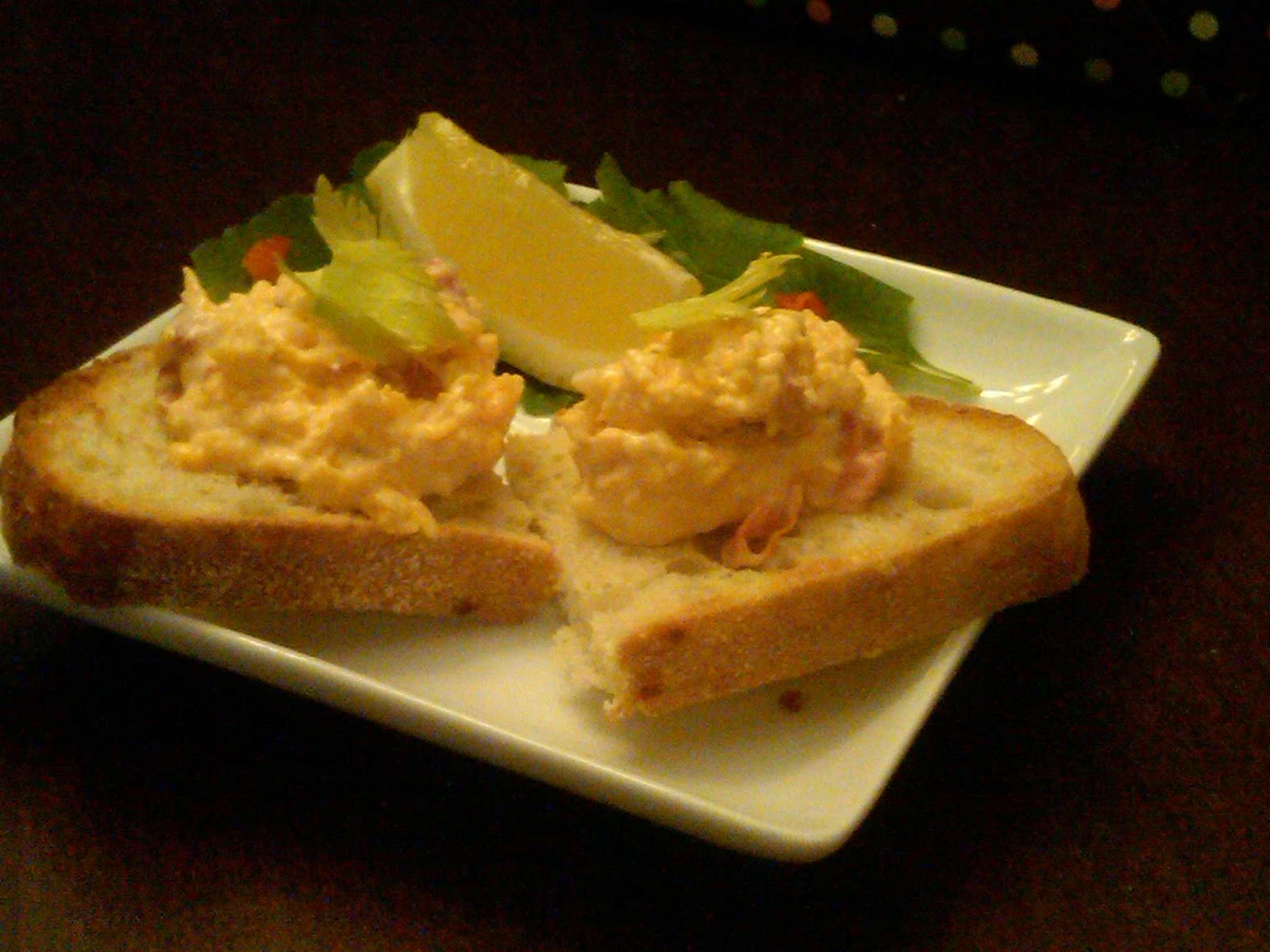
How to serve pimento cheese once it's made is a topic for several more posts, but you can get all fancy and spread it on little toast points (see glamor shot above), or just serve it in a bowl with some crackers around it, or--as usually ends up happening to me--simply leave it in a plastic container in the fridge and scoop out a couple of spoonfuls here and there until it's gone before you get a chance to serve it at any sort of gathering.

It's good stuff.


Popular Posts