Showing posts with label Authenticity. Show all posts

Friday, December 10, 2010

Does Authenticity Matter? The Lee Bros. Simple Fresh Southern

The Lee Brothers Simple Fresh Southern (Clarkson Potter, 2009) 

Right out of the gate I had an immediate visceral reaction when I read the dust jacket for the latest cookbook from brothers (and fellow Charleston residents) Matt and Ted Lee.  The blurb starts off strong: "Matt and Ted Lee grew up in Charleston, South Carolina, immersed in the flavorful traditions--long-simmered gumbos, fish-fry marathons, whole-hog barbecues--that have made southern food the most beloved of American cuisines."  That had me hooked.

Unfortunately, the very next word that follows is "but," and the copy proceeds to explain how busy life is today in this era of two working parents and how the recipes therein are meant to update traditional recipes with lighter cooking methods and new, more modern ingredients.  In fact, not just the dust jacket but the rest of the marketing material for the book sticks to the key themes of "easy", "fast", and "healthy," selling these as "simple" recipes aimed at "the busy home cook."  The Publisher's Weekly review did little to advance the cause, either, noting that the book is an exercise in "applying the principles of the current fashion for simplicity and speed in the kitchen to the revered down-home flavors of the South" and "bringing Southern cooking into the 21st century."

"Fast", "light", and "easy" just isn't my style (and, as my wife will quickly point out, neither is "neat", "elegant," nor "one-pot meal").   In my working drafts folder I have a half-finished piece entitled "In Defense of Slow-Cooked Vegetables" in which I argue passionately for the virtues of simmering vegetables in a dutch oven with a big chunk of smoked meat until they cry "Uncle".  As far back as the early 1990s I was toying with writing a cookbook entitled "Cooking with Lard",  but I never got around to it and two guys named Mike beat me to the punch with a jokey version and then Jennifer McLagen, a Beard Award-winning cookbook writer,  came out with a serious and authoritative tome on the subject.

It would be easy for one to write off the Lee's latest effort by saying "that's not real Southern cooking," meaning, of course, that it's not authentic.

But, if you actually read the recipes in Simple Fresh Southern and not just the dust jacket copy, you'll find that, while the dishes may be light and quick and possibly even healthy, they are really just plain good eating.  In fact, it makes you wonder whether whoever wrote the marketing materials actually read the book or whether they simply plugged a few words into a template designed for today's average cookbook buyers.

I don't think Matt and Ted Lee are on a mission to save us from the the busy bustle of daily life nor the "burden" of homecooking so much as they are trying to rescue Southern cooking from the depredations of the mid-20th Century (and, if you judge by the women's magazines and newspaper food pages, everyone was far too busy to cook from scratch back then, too.)

You don't really find within the Lee brothers' book too many updated versions of the fatback-and-greens, lard-based biscuits, and fried sidemeat dishes that were stereotypical of Southern cooking in, say, 1890.  Instead, you get a lot of updates on the kind of recipe that your great-aunt may have found in one of those spiral-bound community cookbooks and took to her church family night supper in 1962, recipes that usually began with, "Open a can of . . ."

There is, for example, green goddess potato salad, which the Lees note was "dreamed up in a fancy hotel kitchen far from the South"--that is, at the Palace Hotel in San Francisco in 1920.  But, it appears so frequently in mid 20th century Southern cookbooks, they argue, that it might as well be considered Southern.  Matt and Ted use the mayo-and-sour cream dressing (made green with chopped scallions, parsley, and tarragon and spiced with anchovies) to dress red potatoes into a warm potato salad.  It's a definite upgrade from the versions you find in newspaper columns in the 1960s and '70s, which called for things like "2 teaspoons French's Herb Seasoning, 1 teaspoon French's Minced Onions, and 2 teaspoons French's Worcestershire sauce" and was used to dress iceberg lettuce

In New Fairyland Cooking Magic (1964) from the  Fairyland School PTA from Lookout Mountain, GA,
the Lees  found a recipe for "shrimp and deviled egg casserole", an insidious-sounding concoction of deviled eggs layered into a casserole pan, covered with a thick, cheesy cream sauce with shrimp, ketchup, Worchestershire, and sherry, and finally topped with buttered bread crumbs, baked, and served--in a final indignity--over canned Chinese noodles.  What made them think they could rescue such a mutt is beyond me, but rescue it they did, homing in on the potential in the marriage of shrimp and deviled eggs.  The result is an egg salad made with farm fresh eggs, store-bought mayo, dijon mustard and tabasco into which is folded chopped local shrimp with a  squeeze of lemon and smoky bacon and scallions.  The mixture is tucked inside toploading hot dog bun to create a Southern version of a New England lobster roll.  And it looks delicious.

Now, be honest, would you rather have the authentic original or the updated one?

The Lees banish marshmallows and canned mandarin oranges from ambrosia and replace them with fresh grapefruit and oranges and toasted coconut flakes.  Heck, they even take a flyer at reforming Purple Jesus, that iconic college party punch traditionally made with Everclear, citrus juices, and grape Kool-Ade in big plastic trash cans.  Matt and Ted offer up a variant with vodka and soda flavored with cherries, blackberries, and citrus that's more suited for a classy summer front porch party than the kind of affair that leaves you sprawled prone in the bushes.

The book is less about Southern recipes and more about Southern ingredients and preparation techniques.  Watermelon makes its way into margaritas, gets tossed with squid and basil, and is brined into watermelon and onion pickles.  Bourbon is poured with a liberal hand to marinate flank steak, flavor ice cream, and to spike up a fig compote.   There are "shopping notes" on how to find everything from fresh shrimp and oysters to salt and olive oil, and instructional sidebars on techniques like stove-top smoking and quick pickling that seemed aimed a returning some of the old flavors of traditional preservation techniques to the modern-day kitchen, flavors that were lost in the era of canning and freezing.

In this sense, it's a cookbook that's very much in line with the efforts of Linton Hopkins and Sean Brock and all those other chefs who are "reclaiming the soul of Southern food".  Is it "authentic?"  You be the judge.  But, it's definitely good Southern eating.

Tuesday, December 07, 2010

"Authentic" Pimento Cheese

People get passionate about pimento cheese.  It's been called the "Pâté of the South" and "Carolina Caviar."  It's the kind of thing that Southerners get all misty eyed remembering from their youths and Yankees get all wondrous and rapturous about when they discover it.

Like other foods that stir diners' passions--barbecue, for instance--pimento cheese can also stir up a lot of disagreement.  It's the kind of thing that people quickly harden into a "my way or the highway" kind of mentality about.  In fact, every single ingredient can be debated.
Grating the Cheddar (Finely, in this case)


The base of just about every pimento cheese recipe you see today is three-part: cheese, mayonnaise, and pimentos.  But, do you use cheddar, white cheddar, Swiss, Monterrey Jack, Parmesan, cream cheese, or Velveeta (or a combination of several of these)?  Do you grate the cheese finely or leave it in  big ole chunky shreds?


The Basic Foundation: Cheese, Mayo, Pimento
You would think the pimento part would be fairly straightforward, but as I discussed a few days ago, it's not clear whether fresh or canned peppers would actually be more authentic.

And what about the mayonnaise?  Nan Davis of Oxford, Mississippi, who won the Southern Foodways Alliance's Pimento Cheese Invitational in 2003 with a recipe she learned from her Aunt Lella.  As Davis recalls that when Lella taught her the recipe, "She started with 'Well, first you make the mayonnaise'. I interrupted her and said that I was not going to make homemade mayonnaise, just to give me the proportions on the cheese, pimentos, and spices. There was a long pause and then she said 'Well, you might as well not bother'".  Davis has used homemade mayonnaise ever since.

One of my favorite pimento cheese versions of all times is that of Sarah O'Kelley of the Glass Onion here in Charleston.  The Glass Onion is a die-hard farm-to-table, fresh local ingredients kind of place, but O'Kelley is insistent on using store bought mayo for her pimento cheese.  "You must use Duke’s brand,”O'Kelley told Garden & Gun magazine.  "Duke’s has no added sugar and more egg yolks."

Ready for Sampling
I'm partial to Duke's Mayonnaise myself, perhaps in part because I grew up in Greenville, South Carolina, where Eugenia Duke first began making her no-sugar mayonnaise in 1917, and the yellow-labeled jars were omnipresent.

Once you get the first three ingredients in the mixing bowl, the concoction becomes a palette for your culinary creativity, and what each cook adds from there is what makes their "special" pimento cheese recipe so special.  Black pepper, cayenne, jalapeños, lemon juice, onion, bacon, pecans, hot sauce, garlic powder, mustard, cider vinegar, and celery seeds are just a few of the things you might see adding a little zip or kick or twist.

Or, You Could Gussy it Up a Little
When next summer rolls around I plan on going all lardcore and making my pimento cheese with fresh, fire-roasted pimentos, handcrafted hoop cheese, and homemade mayonnaise from Southern-sourced oil (maybe I'll even press it myself from locally-grown soybeans.)  Until then, here's the standby recipe I'm going with for holiday parties and other family gatherings.


Pimento Cheese


8 Oz. sharp yellow cheddar (or 4 oz. sharp cheddar and 4 oz. aged white cheddar)
1/2 cp. Duke's mayonnaise
1/2 cp. pimentos from a jar, drained and chopped into 1/4-inch bits
black pepper
pinch of salt
1/4 cp. diced green onion
1 t. dried mustard
1 t. freshly-squeeze lemon juice
1/4 tsp. cayenne


Grate the cheddar.  Lately I've been using the fine holes on my grater, but (yes, Janet) you could use the larger ones if you prefer big shreds instead.  Put the grated cheese in a large mixing bowl and stir together all the ingredients.  Start with a little less than a half cup of mayo and add a little more once you have everything else mixed in to make sure you get the right consistency--I like mine to be thick but still loose enough to spread easily, and the 1/2 cup of mayo will usually do it.   

I like to make my pimento cheese the day before I serve it so it has a good night in the fridge to let everything merge and meld together.  You can serve it immediately, though, in a pinch.

Lately, I've gone for mustard and black pepper for a little zip, cayenne to add a subtle bit of heat, and lemon juice to brighten it all up.  But, there are a hundred different things you could use instead and come up with a similarly satisfying spread, so here's your chance to get creative.

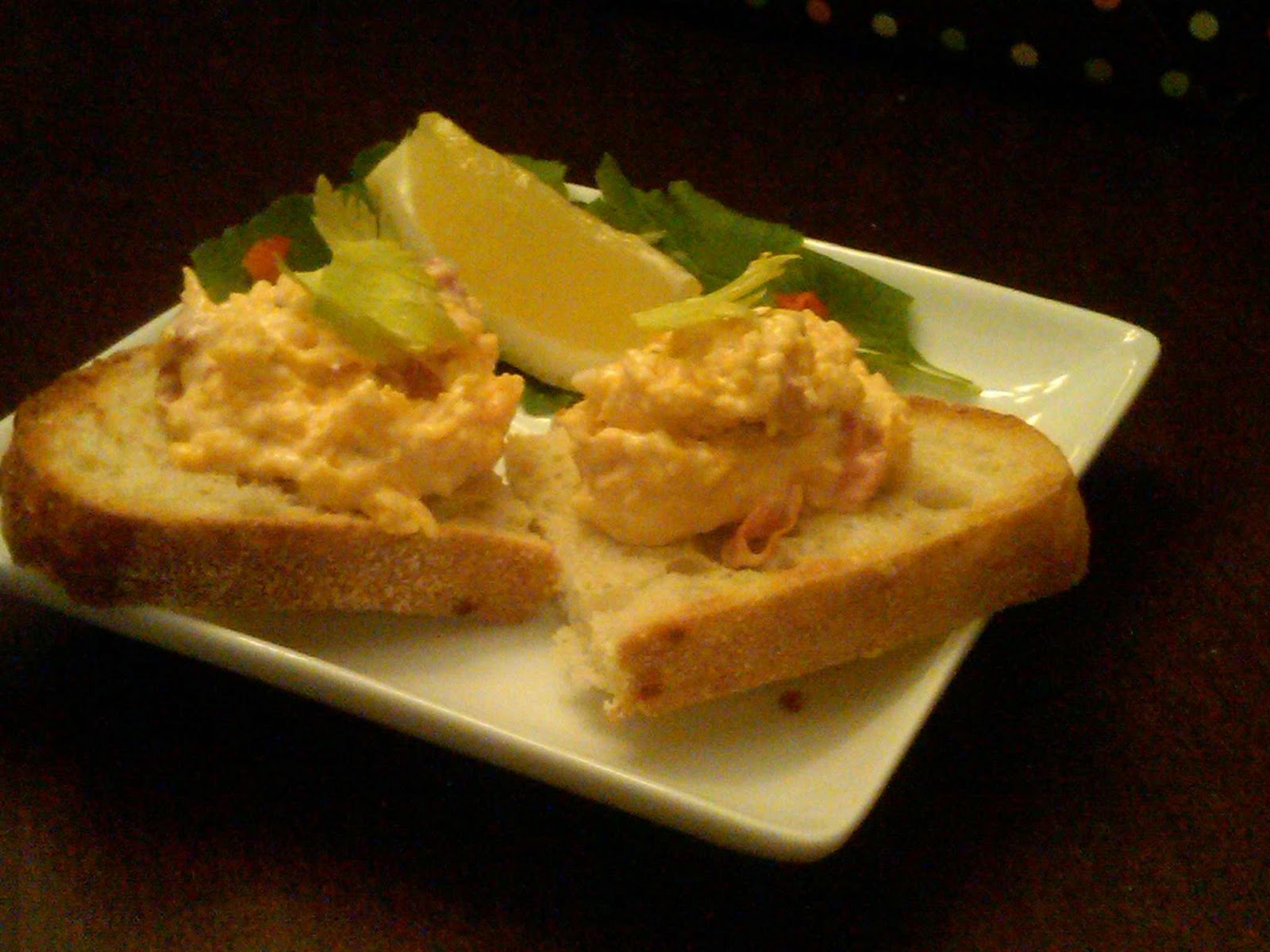
How to serve pimento cheese once it's made is a topic for several more posts, but you can get all fancy and spread it on little toast points (see glamor shot above), or just serve it in a bowl with some crackers around it, or--as usually ends up happening to me--simply leave it in a plastic container in the fridge and scoop out a couple of spoonfuls here and there until it's gone before you get a chance to serve it at any sort of gathering.

It's good stuff.


Saturday, December 04, 2010

Southern Cooking: Does Authenticity Matter?

CNN's Eatocracy blog has stirred up something of a hornet's nest over its coverage of their first CNN Secret Supper at Linton Hopkins' Restaurant Eugene in Atlanta and their celebration of modern Southern chefs like Hopkins, Steven Satterfield,  and Sean Brock, whose passionate, intensive use of fresh, traditional ingredients constitute "a love letter to the cooks, farmers and soul of the South" and "reclaiming the soul of Southern food."

This drew the ire of many commenters who claimed that such food is "no more Southern than braised kangaroo". Why?  Because it's just "some New York Yankee's idea of Southern cooking", and "I've never seen anything like this served on any down home southern table," and--more than anything--it's "not what my grandmother made."   Eatocracy sums it up nicely: "You can't out-cook a ghost."

The editors' invitation to readers to "share your thoughts on the state of Southern cooking" has sparked a full-on flame war with over three hundred comments in two days, and the content suggests it's virtually impossible for us to have a discussion about Southern cooking without everyone starting to talk about where they were born and raised and sooner or later somebody telling the Yankees to go home.

For me, though, it re-raises a question that has been nagging at me for some time, and one that my research into the history of Southern food has done little to resolve: how much does authenticity even matter?

One problem with using authenticity as a measure is that our own conceptions of Southern food history are so slippery.   Take this list of Southern staples: sweet iced tea, pimento cheese, barbecue, hushpuppies, shrimp and grits, fried green tomatoes, RC Cola and moon pies.  Are these things traditional Southern foods? 

It all depends upon  how you define "traditional."  Did it have to be served in the region in antebellum days ("before da wah?")?  Before World War II?  Before Jimmy Carter made the South cool?  Before the turn of the 21st century?  Does it have to be something your grandmother cooked or your grandfather loved to eat? 

And then there's geography: does anything originating in Florida or Texas count? What about foods that were popular not just in the South but in other parts of the country, too?  What about something made by your grandmother who was born in the North but lived in the South her entire adult life?

It's hardly news that Southerners have a unusually strong interest in the past, but too often we seem less concerned with the past itself as we are in employing it as a cudgel in some contemporary argument.   Hate agribusiness and want everyone to start eating fresh, local, organic, heirloom vegetables?  Intimidated or annoyed by expensive restaurants and ingredients you don't recognize and wish people would just serve you a cheap fried pork chop?  Either way you can turn to the some point in the past and find evidence to buttress your position.

I'm launching a series of posts that dig more into this question of authenticity.  The idea is to look at some of the things we're eating and making such a fuss about these days,  how we are talking about them, and the history--both factual and mythologized--behind these "traditional" Southern food.  Does authenticity matter?  Should we concern ourselves with how people cooked and what they cooked in the old days?  Or, should we just shut up and eat?

Gotta go . . . Just made myself hungry thinking about fried pork chops. 

Popular Posts