Monday, October 09, 2006

Trumer Pils


There's a new beer on the Charleston scene . . . or, at least, that was going to be the lead line for this post, until I surfed the web a little and realized I may be a bit behind the times. So, to be more accurate . . .

There's a beer that's new to me on the Charleston scene: Trumer Pils. The label bears two locations: Salzburg and Berkeley, which indicates the beer's origin. The recipe is that of the Trumer Brauerei, a small Austrian family brewery. It was brought to the U.S. two years ago by Gambrinus, Co. of San Antonio, which imports Corona, Modela Especial, and other Mexican beers and owns the breweries that make Shiner Bock and Pete's Wicked Ale. The U.S. version of Trumer Pils is made in the former Golden Pacific Brewing Company plat in Berkeley, California. It is currently distributed in only a limited (but growing) number of states. Charleston, in fact, was the first market in which the beer was released.

Okay, okay . . . but how does it taste? Pretty good, in my view. It's a very light, clean tasting beer, with a nice bitter bite at the end. It's definitely a beer you would want to serve ice cold.

So, even though I'm a year or so late noticing it, it's a beer that is fairly unique to Charleston, and one I'm sure I'll pick up again in the near future.

Sunday, October 08, 2006

The Wild Ride Continues

Brett over at In Praise of Sardines has posted episodes 3 through 5 of his Wild Ride series on opening a restaurant.

Flat-Iron Steak


I've always been a fan of low-budget cuts of meats. Big ribeyes or tenderloin filets are great treats every now and again, but they are pricey and best suited (for my pocketbook, at least) for special occasions. Many of my favorite dishes are rooted in creative ways to transform the less expensive cuts of meat into tasty delicacies (Braised short ribs, brisket, coq au vin, and osso buco come immediately to mind). While many of these require hours of long, slow cooking and are therefore not ideal for weekday cooking after a busy work day, I'm always on the look out of new, tasty, affordable cuts of meat.

So enter the flat-iron steak. I first saw this version of steak cropping up at my local Publix supermarket. It looked like a pretty nice cut and, at around four bucks a pound, was very reasonable priced. So I bought one and took it home and made a very passable steak dinner from it. It's now entered my list of regular weeknight dishes which can be made quickly and, at less than 2 dollars a serving, isn't going to break the bank.

But what is a flat-iron steak? As it turns out, it's a rather recent cut, and one with a lot of science behind it. Also called a top blade steak, the flat-iron is a cut taken from the top of the chuck (don't forget your handy cuts of beef chart, available here) and apparently is the result of some intensive research from a team at the University of Nebraska's Institute for Agriculture and Natural Resources. Working in collaboration with a team from the University of Florida in a project funded by the National Cattlemen's Beef Assocation (yes, there were many people involved in this work), the Nebraskans systematically studied and characterized over 5,500 muscles in the beef chuck and round, searching for new, tender, and inexpensive cuts that traditional butchers had missed (full story here).

One of the cuts they identified was the flat-iron. Because the top shoulder has a big mass of connective tissue running down the middle of it, it looks tough. But, if you cut against the grain and remove the connective tissue, you are left with two thin filets that are exceptionally tender.

I'm always a little suspicious of food born from the science lab, but the flat-iron doesn't involve chemical concoctions or anything like that. It's just a different way to cut up the chuck. Some butchers claim that the flatiron is second only to the tenderloin in overall tenderness. I'm not sure how to verify that, but I cook my flat-iron steaks in the same way I do tenderloin filets, and they always come out great. Below is my standard stove-top version:

Pan-Seared Flat-Iron Steak with Red Wine & Shallot Reduction

2 flat-iron steaks (about 4 to 6 oz each)
coarse kosher salt & pepper
1 shallot, peeled & chopped
2 T parsley, chopped
1/2 cup red wine
1T olive oil
1T butter


Heat a frying pan over medium high heat. When it's hot, add the olive oil. Season the steaks well with salt and pepper and add to pan. Cook on both sides till outsides are brown and crispy--about 3 minutes per side for rare, longer for more doneness.

When steaks are done, remove to a plate and cover with foil to keep warm. Return pan to heat and add butter. Once it is melted, add the parsley and shallots (the smell of the shallots hitting the pan is one of my favorites) and cook until translucent. Turn heat to high, add red wine, and deglaze the pan, stirring with a wooden spoon to get up all the brown bits. Let the red wine reduce till it's a thick sauce; I usually uncover the steaks a pour any of the remaining meat juices into the frying pan, too.

Put the steak on a plate, pour the reduce sauce over the top, and serve.

I usually serve this with mashed potatoes and either green beans or a salad. From start to finish I can do that meal in less than 45 minutes, with the steak taking only 15 or so, so it's perfect for a weeknight.

Saturday, September 30, 2006

No Mo' Mofongo


I was back in Puerto Rico this week for another quick (one-night) trip, but this time I got to stay long enough to try more than the mojitos at the hotel bar. I got in in the late afternoon, early enough to enjoy the breeze and a couple of cold Medallas (a local Puerto Rican beer) at the hotel's ocean-side bar and watch out over the waves as the sun set.

Dinner that night was at the Ceviche House, a Peruvian restaurant (I know, I know, as with the mojitos I'm having a hard time keeping my regional specialities straight--but, it's not like I can get Peruvian food in Charleston, South Carolina . . .), and I was fortunate to be eating with a bilingual colleague who could help me not only navigate the menu but also chat with the waiter about the food and its preparation. The dinner was good--I had a nice dish of steak in a peppery sauce--but the appetizers stole the show.

We had, of course, ceviche, which was fantastic--firm, tasty fish marinated in a tangy blend of citrus, onions, and peppers. But, my favorite was the fried yuca. Yuca is a potato-like tuber, better known in the U.S. as cassava. It was cut into wedges and deep fried, and they served it with two different sauces. The first was a white, creamy sauce with just a hint of spice; the second was a much more pungent green sauce that was very strong with garlic. Both went quite well with the yuca wedges, but the spicier green sauce was my favorite. In Peru, the waiter told us, they would serve just one sauce with the yuca, which would be sort of a combination of the white and green sauces, but in Puerto Rico--where the food isn't as spicy as in other parts of the Caribbean--they had to serve the milder, creamy white sauce or none of the locals would eat the dish. The yuca has a very distinctive taste to it--definitely somewhat like a potato, but firmer and with a subtle aftertaste. We made short work of it.


But, yes, I finally did get a chance to sample the local Puerto Rican cuisine. At lunch the next day we went to Mi Casita, an unassuming place in a strip mall, but my colleague assured me it was great local food. As soon as I saw Mofongo on the menu, I knew what I was going to have.

Mofongo is a Puerto Rico staple--a hearty starch that is the base for many different types of meals. It is made from green plantains which are fried and then mashed with garlic and pork cracklings. In some places the Mofongo is rolled into balls, and often it is filled with meat or seafood. At Mi Casita they mold it into a large tower-like mound and cover it with your topping of choice, which include shrimp, beef in a creole sauce (pictured above), and carne frita (fried pork). We ordered the beef and the carne frita, which I judged my favorite. The pork bits were salty and juicy--fried lightly without a batter--and went well with onions and peppers that came alongside it.

As for the mofongo itself, it was fairly bland (especially considering it was mashed with garlic), but had a great heavy texture. You might think that the plantains (being related to bananas) would be sweet, but they really are not--especially the green ones. By itself I wouldn't think mofongo would be much of a dish, but it goes perfectly with highly-flavored accompanyments like the pork or the beef. And, the menus really ought to carry a big red label saying, "WARNING! THIS MEAL WILL STUFF YOU SILLY!"

I had wolfed down only about a quarter of my carne frita before I started to feel full, but I soldiered on. Five minutes later I had put away a good about half of the mound of plantain mush, but then I had to throw in the towel. I was painfully full. The waiter laughed and said something to my Spanish-speaking colleague when he cleared away our plates, and I picked up just enough to figure out what he was saying. "He was making fun of us, wasn't he?" "Yes," she said. "But I won't tell you what he called you."

It stung my pride a little, but there wasn't much I could do. We had an afternoon flight, so we left Mi Casita and drove to the airport. I must have checked in and went through security and all that, but it's all just a plantain-induced haze in my memory. I was stuffed. I was sleepy. It was all I could do to trod down to the gate and get on the plane.

I managed to stay awake long enough to watch the island fall away beneath us as the plane arced out over the Atlantic and back over the city then headed northwest toward Atlanta. Then I fell into a cozy, satisfied, mofongo-fueled sleep.

Monday, September 25, 2006

Crab Cakes

We spent last weekend at Sunset Beach, North Carolina, with my parents, just hanging out and relaxing and--of course--eating. Blue crab was the order of the day. From the dock (pictured above), my father and my son teamed up with a single crab trap baited with chicken necks and caught so many crabs in the first 24 hours--almost two dozen--that they stopped throwing the trap in the water: we'd caught all we could eat.

Or, perhaps more accurately, we'd caught all that anyone cared to clean. It isn't a fast process. My mother and I picked the crabs, using nutcrackers and little skewers and any other small tools we could find to eake out the tender white meat from the shells (we didn't have any crab pickers--little hook-like devices that make the cleaning much, much easier). Saturday night for dinner I made crab crakes. My recipe, which is one of those things that is very imprecisely measured and whose ingredients vary each time based upon what I have on hand, went something like this:

Crab Cakes

One big plastic tub (approximately 1 lb.) of blue crab meat, boiled or steamed, removed from shell, and well picked-over
1 egg
1 Tbsp dijon mustard
2-3 Tbsp mayonnaise
1/2 small onion, minced
1/3 medium green pepper, minced
several pinches of minced parsley
a few dashes of hot sauce
salt & pepper to taste
Approx. 1/2 cup bread or cracker crumbs, plus more for coating
butter and/or olive oil for frying

1. Combine the crab, egg, mustard, mayo, onion, green pepper, hot sauce, salt, and pepper in a large bowl and mix well.

2. Stir in enough bread or cracker crumbs to bind the mix together.

3. Spread the remaining bread or cracker crumbs on a plate near the stove.

4. Heat a large frying pan over medium-high heat, adding in enough butter and/or olive oil (I use a mixture of the two) to coat the bottom of the pan in a thick layer.

5. While the oil is heating, pat the crabmeat mixture into small, thin cakes (about 3 inches in diameter and 1/2 to 1 inch thick) and dredge on both sides in the remaining bread or cracker crumbs.

6. Saute the cakes in the butter or oil, turning once, until golden brown. This usually takes 3 to 5 minutes per side.

7. Remove to a plate lined with paper towels and allow to drain.

8. Serve with cocktail sauce or the sauce of your choice.

Monday, September 11, 2006

Jim's Steaks


I was in Philadelphia on Thursday, and that meant cheesesteaks for lunch. Our host, the inimitable Rob Armstrong, is a Philly native, and he offered to serve as our guide, driving us through a maze of narrow one-way streets down to South Street. Jim's Steaks is at the corner of South and 4th.

It's a great old art deco building, a small, two-story place with a floor of tiny white and black tiles and larger white tiles on the wall. The downstairs is narrow. To your right as you walk in the door is a single row of stools along a narrow counter for dine-in customers (there's more dining space upstairs); to your left is the line where you order. And the whole place is filled with the fantastic aroma of sizzling beef.

The most impressive thing about Jim's is the grill--griddle might be a better term, since it's a single long metal surface. As you stand in line preparing to order, you're right in front of it and can watch the griddleman working the steaks. The meat is piled up along the griddle from left to right (from the customer's perspective), starting with a huge mound of paper-thin sliced top round. Using a giant flat spatula, the grillman works the meat from the left side of the griddle to the middle, flipping, turning, and chopping it with the spatula, moving it gradually as it cooks over to the right side of the griddle, where the fully-done meat nestles next to a massive pile of sauteeed onions. And, at the far left, is the classic emblem of the cheesesteak joint: a gallon-sized metal can of Cheez Whiz, its top removed, set right on the griddle to keep warm, a big ladle sticking from the top, ready for scooping. (Unfortunately, I didn't have my camera with me, but the images at the Roadfood site capture this experience well.)

Armstrong helped guide me through the proper lingo for ordering. You have a choice of Cheez Whiz (which should be ordered just as "whiz"), American, or Provolone cheese, and can add onions, peppers, mushrooms, lettuce, and tomato. Onions are special and are ordered via shorthand. If you want them, you don't say "with onions"; you just say "with". So, a Provolone cheesesteak with onions and mushrooms is a "Provolone with and mushrooms"; a Cheeze Whiz with no onions is a "Wiz without".

Much has been made about the ordering rules at Philly cheesesteak restaurants, with writers offering dire warnings that you'll be thrown out on your ear if you breach the protocol. In realilty, you just have to remember that Philadelphians are usually in a hurry and are not overly constrained by good manners. As long as you order quickly and don't hold up the line you'll probably be fine. But, saying "gimme an American with and peppers" is just fun.

Sure, CheezWhiz is available at every cheesesteak place, but I suspect that's some kind of cruel joke Philadelphians like to play on tourists. Armstrong got his with American cheese, and I followed suit. (American, in this case, is a thinly sliced white American cheese--much, much, much better than that yellowish Kraft cheese food stuff.) And it was GOOD.

"The thing that makes a great cheesesteak," Rob Armstrong said as we tore into our steaks at the little dining counter along the wall, "is not the meat or the cheese or any of that. It's the bread." And, I have to agree with him on that. Jim's uses 7" Italian sandwich rolls from Amoroso Bakery--itself a Philadelphia tradition--that are delivered fresh daily. And the bread is definitely different than the kind of soft hoagie rolls you get in the supermarket. The outside is slightly crusty, and the inside nice and chewy. It makes a perfect platform for soaking up all the juices from the steak and the melted cheese without getting mushy.

I washed my cheesesteak down with a Dr. Brown's Black Cherry Soda and was a happy guy.

Philadelphians argue over which joint has the best steaks. Pat's and Geno's--located on opposite corners of 9th Street and Passyunk Ave. in South Philly--often win high marks, but they also get tagged as "tourist spots." Jim's is right up there, too. Rob Armstrong confided that as good as he think's Jim's is, he actually prefers Geno's which "doesn't go through me as fast, if you know what I mean." (Like I said, he's inimitable.) But, I had no issues with it. Uncorrupted by any exposure to a Pat's or Geno's steak, I'm voting for Jim's.

Sunday, September 03, 2006

Muscadines are Here


Down at the Marion Square Market yesterday, I found tray after tray of muscadines for sale. This grape variety--often called scuppernongs, after one of the more popular varieties--is native to the Southern U.S. They start to ripen around the end of August and will be available until October.

The color of muscadines range from a bronzy green to deep purple. They are something of an acquired taste, it seems, and I can see why. The skins are very firm and have a bitter taste to them, but the inner flesh is very soft and sweet. When you pop one into you mouth, you have get crispiness and softness, bitterness and sweetness, all in the same bite. Eating muscadines always takes me back to my young childhood in Great Falls, SC, where some of my father's friends grew them out on their farmland and we would eat them fresh from the vines. They're a true Southern treat and won't be available for long.

Saturday, September 02, 2006

Welcome to France

I love David Lebovitz's blog. His writing about food is great, but I enjoy his pieces on being an American resident in France even more, like this one.

Back to Nature

Thursday, as the outer bands from Tropical Storm Ernesto rolled over the city and dumped several inches of rain onto Charleston, my company decided it would be nice to order in pizza for the whole office so no one would have to go out into the rain. So they did, which was a really nice thing to do, but for me it was the straw that broke the camel's back. The straw, that is, of unnatural food.

The lunch was pizza from Papa John's supplemented with bags and bags of Doritos and other snack chips, 2 liter bottles of soda (including lots of Mountain Dew), and bags of Oreo and Chips Ahoy cookies. (Yes, I do work at a software company--how did you guess?)

Now, I'm not one to put up my nose in the air and sneer at pizza, Oreos, and Coca-Cola. But, I've been on the road a bunch of the past month and, frankly, my diet has been nothing short of lousy--fast food grabbed in airports, candy bars from vending machines, take-out pizza and Chinese on the days when I've been at home but too tired to cook.

The tropical storm luncheon put me over the edge. I can't eat like this anymore.

This isn't one of those things where you think: gee I better cut back a little. This isn't an intellectual thing, nor a moral thing, nor a health thing. It's a raw physical revulsion to industrial food.

I'm shot. I'm through. I can't take another dose of high fructose corn syrup, guar gum, or modified corn starch. I want to purge my system, eat clean. And I don't mean wheat germ or bee pollen or any of that natural food store stuff. I mean just good old fashioned food from nature. I don't want to put anything into my body that wasn't available to humans before the Industrial Revolution.

It's also not an easy thing to do. At work, I'm surrounded by people who are too kind: they bring in Chick-Fil-A biscuits and Krispy Kreme donuts and bags of gummy worms and cookies and candies and pass them around for all to share. What a wonderful gesture! But, my stomach physically aches any time I think about another mouthful of candy or a bite of pepperoni pizza.

So, my plan is to go fresh & natural: no more fast food, no more candy and sodas. Coffee is fine, as is iced tea: foods made from packages whose ingredients list has no commas: "ground orange pekoe tea leaves." No more peanut butter crackers or donuts for breakfast. Fruit, lots of fruit. Good bread with real butter. Homemade meals. And, for Pete's sake, no more high fructose corn syrup.

I've done okay the past two days, but the challenge will be when I get back to work on Tuesday. We'll see how long I can hold out.

Thursday, August 31, 2006

Twenty Four Hours, Four Flights, and One Mojito


I flew out for Puerto Rico at 4:00 PM on Sunday, changed planes in Atlanta, and got into San Juan just a little before ten. The tail end of tropical storm Ernesto was just passing by the island, and the tropical night was warm and rainy.

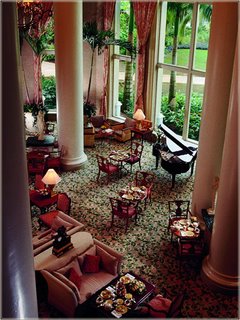
We were staying at the Ritz-Carlton, a massive ocean-front palace with a full casino and a spa lots of dark wood and marble in the lobby. So far so good. The problem was: I had an meeting the next morning at 7:30 am and, because of other commitments back home, a flight out at 2:30 PM that afternoon. All in all, just 17 hours on the ground, including sleep time. No time for sopa de arroz con pollo, no time for plantain tostones, and not even enough time for lechon asado (barbecued pig). Not even enough time to snap any pictures (I borrowed the one here from the Ritz Carlton website.)

At least I got a good mojito.

Okay, so it's really a Cuban drink, but the rum was Puerto Rican, and it was advertised as the specialty of the house at the Ritz-Carlton Lobby Lounge, where my colleagues and I had a drink and watched as the tropical rain pounded down outside. It seemed like the thing to try. And it was really, really good.

Mojitos are a big trendy drink in the U.S. now--so trendy that Delta airlines was flogging them onboard the plane on the trip down, made I'm sure from some high-fructose mix. Most mojitos I've had have been, frankly, pretty disappointing--a mess of soda water and undissolved sugar and annoying clumps of mint leaves. I've made them at home, too, but they've always come off as too strong--either too much of an alcohol bite from the rum or too sour from the lime.

So, when I took a sip of the one at the Ritz-Carlton and found it a perfect smooth blend of sweetness, sourness, and mint, I kept one eye on the bartender and took notice the few next times he made mojitos.

The ingredients were simple: rum, fresh lime juice, sugar, and mint with just a touch of soda (not half a glass of soda, as I've seen it made in too many places). And, smooth as it was, it wasn't because he skimped on the rum--the doses, in fact, were pretty darn generous. The key, it seems, was in the muddling. In most mojitos I've had, the mint is beat up a little in a cocktail shaker, sometimes with a spoon and sometimes with an actual wooden muddle. At the San Juan Ritz, the bartender used an actual mortar and pestle (both wooden, I think) to not just crush the mint leaves but to pulverize them. The resulting drink was not clear with little bits of green mint leaves floating around inside but rather a bright, neon-green liquid. Lots of little bits of mint were suspended in the liquid, but so tiny that they didn't stick to your tongue and clog up the works while you were drinking. It was so good that I wanted a second one, but I had to be up in five hours, so it was off to bed.

The only other island specialty I got to sample was the coffee, which is grown locally and brewed up thick and strong--more like an espresso than the typical weak mainland brew, and served in appropriately small cups. At our meeting that morning, most of the attendees took their coffee con leche, with a health dose of warm milk added and mixed in. A carafe full of milk was kept warming on one of the coffee-machine burners just for that purpose. I had mine black, and its strong, rich flavor helped kicked the morning into gear. Then it was a blur of meetings, high speed rides to the airport, and racing for the airplane gate.

With any luck, I'll be heading back to Puero Rico again in the near future, and next time I plan on staying at least long enough to eat dinner.

Popular Posts