Thursday, October 07, 2010

A Lost Southern Delicacy

What could be more Southern than pimento cheese and boiled peanuts?  How about the two of them mixed together?

My recent research has led me into the origins of various Southern foods, and recently I uncovered this gem from George Washington Carver's Bulletin Number 31 of the Experimental Station at the Tuskegee Normal and Industrial Institute (1916).   Carver, the famous peanut innovator, included the following recommended peanut recipe:

PEANUT CREAM CHEESE WITH PIMENTO 

To every pound of cream cheese grind ½ ounce of pimento pepper and one ounce of peanuts in the same way recommended for the above [a recipe of “peanut cream cheese with olives”]. 

This recipe was part of Carver's treatise “How to Grow the Peanut and 105 Ways of Preparing it for Human Consumption”  It appeared as  item #102 on the list, well after dozens of scrumptious sounding candies and desserts and even after such dubious concoctions as Liver with Peanuts (#37) and Peanut Macaroni and Cheese (#46). While ambitious in its combining two items that were well on their way to becoming iconic Southern foods, Carver was notably unsuccessful in getting peanut pimento cheese to stick.

Two great tastes that taste great together?  You be the judge . . .

Tuesday, October 05, 2010

Hey, I made it into Wikipedia!

No, not my own entry, but as an authoritative source on the history of barbecue sauce.

And, no, I was NOT Googling myself.  What makes you think that?

Monday, October 04, 2010

Are we at a lull?

I always like pondering food trends, and I have great fun trying to prognosticate them, though in reality I am so poor at predicting trends it seems the only safe way to try it is with tongue firmly in cheek.  That's the ultimate "win-win"--okay, sorry--the ultimate cop out.  If I get any of them right I can claim to be a genius; if I get them wrong (and I usually do), well, you see, it was all just a joke, right?

So what's happening these days?  Where is it all going?

Beats the hell out of me.  Right now I feel like we're in sort of a lull, stuck somewhere between the ebbing of "locavorism", which is still the most prominent trend in the food world today, and whatever is going to succeed it.

Don't get me wrong.  Locavorism, despite its ludicrous name, is still hot. Just this week, the National Restaurant News declared  gardens to be the hottest restaurant trend of 2010 (thanks to Robb Walsh via Twitter for the tip).  But, you have to admit, it's starting to feel a little stale.  It seems like something is about to turn, that we're on the cusp of something new and dramatic breaking loose.

Maybe its a reflection of what's going on in the country and the world at large: the pending November elections?  This lingering recession/depression thing?  We got all into the weeds of it back in late 2008/early 2009 and made a big fuss and did a lot of soul searching, and then it seemed for a while earlier this year that things were starting to slowly, inch by inch, get a little bit better.   Then a few months ago it all ground back down to a halt and perhaps even turned back a little in the wrong direction.

Mostly, though, it just feels like we're on hold, waiting in limbo for something to happen, but we aren't really sure what it's going to be or even what we want it to be.

Maybe it's just me and the particular spot I am in in my life, but I feel like there's something looming out there--good, bad, or just different: who knows?  But something is pent up behind the dam and ready to break.  I don't care to speculate about global economics, but in the food world I'm waiting for something exciting and new to happen, too.

The Internet has knocked food journalism into a tizzy, with food magazines on the ropes, traditional publishers struggling, and even a turnover in the old warhouse profession of restaurant reviewing (which really isn't that old of a profession, since we've had computer scientists and astronauts for about long as we've had restaurant reviewers.)  But, somehow Yelp and iPhone apps just don't seem like they're really the way of the future.

Whatever it's going to be, it's going to be new.  We need something different: a hot new trend.  Food trucks have official worn out their novelty, and they were always sort of a mobile locavorism anyway.

So, what's next?  I don't know.  But I have just two words: bring it!

Thursday, September 30, 2010

Godspeed, Buccaneer, and Fair Winds!

The City Paper reports that The Buccaneer is closing its doors today.  I reviewed it back in 2009 when it first opened, and went back once or twice afterwards, and I always thought it was an interesting blend of good, solid food served in a tourist-friendly environment.   (That review, oddly enough, actually provoked someone to leave a comment defending the quality of the restaurant scene in Myrtle Beach.  Go figure.)

The company's press release blames the challenge of opening a "large capacity family-style themed restaurant in a very difficult economy."  There's surely a lot of truth in that, but I also think its out of the way location--hidden away on alley-like Faber St. just off of East Bay--probably didn't help.  It simply wasn't the kind of restaurant you would stumble upon unless you were looking for it, and even trying to give someone directions on how to get there was something of a challenge.

Nevertheless, I'll have fond memories of knocking back a Legendary Painkiller or two and wolfing down spice-laden shrimp-and-tasso-stuffed collards.  Blimey, matey.  We'd barely said ahoy and now it's gangway and godspeed!

Tuesday, September 28, 2010

BBQ Sundae Part 3: The Trend Continues

A few months ago I noted the rise of the barbecue sundae, the newest new-fangled way to make barbecue portable.

Now, the good folks over at Thursday Night Smackdown report finding the perfect accompaniment for your BBQ sundae at the Hamilton Park BBQ Festival: banana pudding in a jar!

Sunday, September 26, 2010

Closing for the Season


No, I'm not shutting down the blog or anything.  But I feel like I should find something to close temporarily, since I'm officially in an "end of the season" sort of mood.

We spent the late afternoon at the neighborhood pool, enjoying the golden sunset that comes earlier each day now.  It was probably our the last visit to the pool this year.  Labor Day is long behind us, the boys are back in school, and September is coming to a close.  And that means autumn, which arrives late on the South Carolina coast, is finally upon us.

Fall is without question my favorite time of the year, and since the summers here in Charleston are long and oppressively hot, autumn always comes as a long-anticipated relief.  But, it's a wistful time, too.

I've always loved going to the beach in the late fall and early winter, long after the last party of vacationers have packed up their minivans and roof-rack containers and headed back to their regular lives somewhere else.  The amusement parks and pancake houses and souvenir stands, idle and shuttered for the season, hold a strange sort of stark, wistful beauty, half melancholy and half sweet.  The bustle and noise and heat of the summer lies behind us, and a cold, slow winter lies ahead.

A new season and all its energy will come again, somewhere off in the distant future, but for now it's time to rest and wait.

Saturday, September 18, 2010

Results: BBQ History Quiz #3

So, I got a little behind and didn't give out the answer for BBQ Quiz Question #3 on time.  Here it is  . . . finally.

This one was rather undramatic, since right out of the gate pretty much everyone got the answer right:

Question: Which regional barbecue sauce style is most like the sauce used at 19th century barbecues?

Responses:
A. Midlands S.C. (mustard-base): 11%
B. Eastern N.C. (vinegar-based): 66%
C: East Texas (tomato-based) 0%
D: Memphis (tomato & molasses): 11%

The answer, as most respondents knew, is B: Eastern North Carolina.  Perhaps it's because Eastern North Carolina sauce is so simple that it seems old, or perhaps it's just common knowledge, but the thin, spicy, and vinegar-based does appear to be the closest thing to the original American barbecue sauce.

One of the great differentiators in regional barbecue styles today is the sauce. In Eastern North Carolina it’s thin, spicy, and vinegar-based while in Texas it’s sweet, thick, and tomato-based. Some variations—like the white mayonnaise-based sauced from Alabama and the yellow mustard-based sauce from my home state of South Carolina—are specific to only a narrow region and not widely known in other places.  These famed  regional sauce variations are relatively recent developments. In the 18th and 19th centuries, the sauces used for barbecue followed a consistent formula throughout the colonies and then the early United States. 

Perhaps the earliest instructions for pit-cooking barbecue appears in Lettice Bryan’s The Kentucky Housewife (1839).  For sauce, Bryan called for “nothing but a little salt-water and pepper, merely to season and moisten it a little.” Once the meat was done, Bryan advised cooks to “squeeze over it a little lemon juice, and accompany it with melted butter.” Three decades later, Mrs. Annabella Hill, from La Grange, GA, published similar directions in Mrs. Hill’s New Cook Book (1872), though her recipe incorporated butter and a little mustard into the basting liquid: "Melt half a pound of butter; stir into it a large tablespoon of mustard, half a teaspoonful of red pepper, one of black, salt to taste; add vinegar until the sauce has a strong acid taste.” At the end of cooking, “pour over the meat any sauce that remains.”

This basic combination of butter or some other fat, vinegar, and pepper was the standard sauce for the rest of the 19th Century. An 1860 account of a Virginia event described iron vessels positioned along the side of the pit, ”some filled with salt, and water; others with melted butter, lard, etc. into which the attendants dipped linen cloths affixed to the ends of long, flexible wands, and delicately applied them with a certain air of dainty precision to different portions on the roasting meat.”  A Harper’s Weekly 1896 account of a Georgia barbecue noted that the meat was cooked for twelve hours and “basted with salt water . . . then, just before it is eaten, plentifully bedabbled with ‘dipney’—a compound of sweet country lard and the strongest vinegar, made thick and hot with red and black pepper.”

Texas today has not one but at least four separate barbecue styles, but before the 20th century it was pretty much the same as its Eastern cousins.   On a Mexican Mustang Through Texas, an 1883 travelogue, described a barbecue outside San Antonio with a sauce almost identical to that used in Virginia and Georgia: “Butter, with a mixture of pepper, salt, and vinegar, is poured on the meat as it is being cooked.”

The regional variations in barbecue sauces developed in the 20th century, driven largely by the rise of barbecue restaurants and the specialization they fostered.  Of all the modern variations, the simple Eastern North Carolina style of vinegar and red pepper sauce seems most like what was used in the earliest barbecues in this country.

For more results from past questions, see Barbecue History Quiz Question #2

Tuesday, September 14, 2010

The Raw and the Cooked (Mostly Cooked)

This City Paper blurb about the new Sunday brunch buffet at the Woodlands mentions a "raw bar of local shrimp and crab claws," which got me thinking about raw bars. I've noticed on several occasions recently "raw bars" where little if anything is raw. Oysters on the halfshell: those are typically raw. But shrimp? Crab claws?

Another local restaurant I visited recently had only a single raw item (oysters, of course) on their "raw" bar but plenty of cooked ones, including shrimp cocktail, crab louis, and steamed snow crab legs.

"Shellfish bar" would be more descriptive, but in reality, are any things raw other than oysters served on a raw bar these day? Clams, perhaps, but you never see them raw in this town. Sushi, yes--but that never appears on a raw bar menu but on a separate sushi menu. So where did the "raw bar" term come from, anyway?

Mystery abounds.

Sunday, September 12, 2010

Newbie from L.A. Discovers Charleston Cuisine

Jessica Garrison of the Los Angeles Times gives a starry-eyed account of her Charleston restaurant tour.  She admits that before this trip, she had not "spent even five minutes in the South," so it's a fun snapshot of a diner's first introduction to Lowcountry culinary delights.

Edisto's Po Pigs Bo-B-Q (yes, that is spelled correctly, after owner Bobo Lee) gets a glowing mention, as does dinner at FIG and brunch at Hominy Grill.  If you had to pick just three spots for lunch, dinner, and breakfast, those are pretty good choices.  (And, such continued publicity will do nothing to help reduce the ever-growing line of tourists on the Rutledge Avenue sidewalk on Saturday morning.)

I have to call foul on just one thing, though: the narrative hook that opens of the story: "Our waiter was staring at us in disbelief," Garrison writes.  "Finally, he leaned forward and, ever so politely, asked my husband to repeat himself."  The husband, it turns out, was inquiring of his waiter at FIG where they might go next to try more Charleston culinary specialties, after the couple had just finished three appetizers, a soup and two main courses.

Now, either it was the waiter's first week on the job, or maybe he just couldn't hear the husband the first time.  Asking where to go next is just par for the course when you're trying to cram in a full week of dining in a single weekend in Charleston, and I can't imagine any seasoned downtown waiter being phased by such an eminently reasonable request.  (I would have advised McCrady's, by the way, for a post-prandial pre-Prohibition cocktail and a few of the bar snacks like pimento goat cheese or ham hock and jalapeno boiled peanuts.  There's always room to squeeze in a few of those.)

Thursday, September 09, 2010

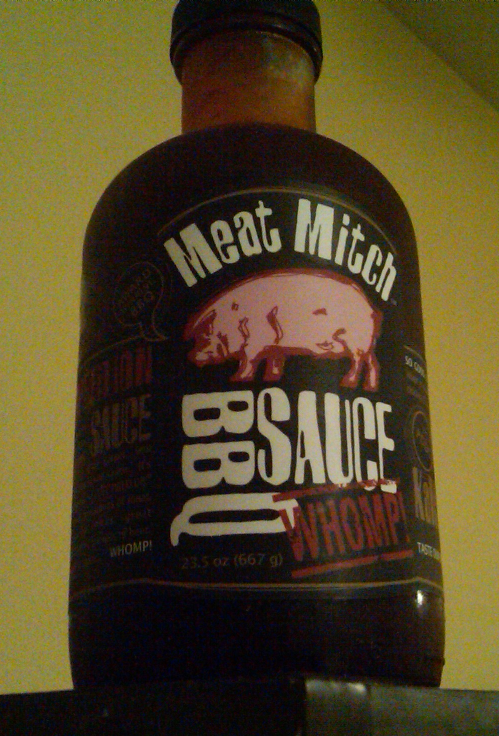
Meet Meat Mitch

A few weeks ago, a friend of mine from Kansas City sent me a bottle of Meat Mitch BBQ Sauce, which some friends of hers--part of a KC-based competition barbecue team--have just put out on the market.  I tried some right away, and thought it was pretty good, but you really need to let these things sit and percolate for a while.

So, over the past few days, I tried it here and there on some barbecue chicken wings, on some left over pork ribs, and on some of my own home-cooked chopped pork.  And, in all instances, it held up quite nicely.    It's a sweet, dark-brown concoction very much in the Kansas City vein: brown sugar and ketchup are the primary ingredients, and it's got a pretty considerable spice kick to it.  And, one of the ingredients might surprise you: vanilla extract.  Not a typical thing to find in barbecue sauce, but if you pay close attention you can detect a very subtle, sweet vanilla flavor underlying the spice.

On the label, Meat Mitch advises, "When in doubt, JUST ADD SAUCE!  Use it for ribs, steak, brisket, pork, foie gras, chicken, 9 irons, eggs, your mother-in-law, use it to water flowers.  WHOMP!"  This might be pushing things a bit.  But, it makes me wish I had some proper burnt ends to give it the true test on.

I may be a South Carolina boy, and I have a big plastic squeeze bottle of homemade mustard-based barbecue sauce in my refrigerator at all times--useful on everything from chopped pork to pickled okra.  Still, I have a long standing fondness in my heart for Kansas City barbecue, and Meat Mitch's sauce is a little reminder that I need to get out west of the Mississippi very, very soon.

Popular Posts