Since it was just my wife, my son, and me for Christmas dinner yesterday, I skipped the traditional turkey and went with a roasted chicken instead. This is something we eat in our house at least once a week. It's one of the most basic dishes there is, and also one of the tastiest. And it's blissfully easy to make.
Preheat the oven to 350 degrees. Take one 3-4 pound broiler chicken. Remove the livers, necks, and other stuff in the body cavity (I freeze the chicken necks and use them for stock).
Create a rub for the chicken by combining the following: 1 clove garlic diced fine, 1 T kosher salt, ground black pepper, and about a teaspoon each of whatever spices you have on hand. I typically use minced parsley, rosemary, thyme, and marjoram. Stir in enough olive oil to make a thin paste (1 to 2 T, usually).
Place the chicken breast-side down in a roasting pan or other ovenproof disk (I use Pyrex baking pans) and smear a few teaspoons of the paste over the back and legs of the chicken. Turn the chicken over breast-up and coat the skin with the rest of the rub. Put in the 350 degree oven and bake 1-1/4 to 1-1/2 hours, until the cavity juices run clear. You may want to let it sit for 10 minutes or so before carving and serving.
It's about as simple as can be, but a roasted chicken is one of the those indescribably good comfort foods. My wife and I are nuts for the crispy, salty skin and usually peel off most of the breast skin well before the chicken makes to to the table.
Sidenote on selecting chickens: For years I've been using the regular 3-4 pound broilers when roasting chicken, probably because they are so cheap (less than $4 bucks, usually). The few times I've tried going upscale and purchasing one of those $7 to $10 roasters I have been bitterly disappointed. Everything I have read has said that roasters (which are larger and older birds) have better flavor than a broiler, and in a sense that is true in that the meat itself has a stronger flavor while a broiler tends to be very mild. But, my roasters have always come out with an unpleasant toughness to the meat, especially in the dark meat, which is my favorite part. I suspect it may be because of the lower fat-to-meat ratio, and fat's what make things tender and tasty.
Part of me suspects the roaster may be, like grass-fed beef, one of those things where once you get used to the difference you begin to appreciate the tougher texture and stronger flavor. It's twice as expensive, after all, so surely it must be better? Perhaps in the name of gastronomy I should go for the roaster and teach myself to like it.
But I'm not going to. I'm sticking with the broiler. It's just so damn good.

Monday, December 26, 2005


Sunday, December 25, 2005
Beef Misinformation
I know nothing about Ingrid Newkirk, and the animal rights movement interests me very little. But, while while searching the web as part of my ongoing (and slow moving) research on the history of barbecue, I came across this gem from Newkirk's book Making Kind Choices: Everyday Ways to Enhance Your Life Through Earth- and Animal-Friendly Living. Newkirk, the President of PETA and a militant animal rights activist, wrote the following:
The interesting thing is that in the midst one of the most colossally ignorant sentences that I have ever read, Newkirk actually mentions a real person from barbecue history. Henry Perry was born in Shelby, County, TN (the county in which Memphis is located) in 1875. He bounced around the Mississippi area for a while, working as a steamboat cook and kitchen hand, before settling in Kansas City in 1907. Long before the Depression (which Ms. Newkirk may not realize took place in the 1930s), he opened a barbecue stand in a Bank Street alley, where he cooked meat over a wood-filled pit dug into the ground, selling ribs wrapped in newspaper for 25 cents per slab. As his operation grew, Perry moved several times, winding up in an old trolley barn at 19th and Highland. Several of Kansas City’s legendary barbecue men apprenticed under Perry, including George Gates and Charlie Bryant. In the 1940s, Gates took what he learned and opened his own restaurant with a partner; he later passed his knowledge down to his son Ollie, who opened Gates & Son Barbecue at 47th and Prospect, which is now one of the legends of the Kansas City Barbecue scene. Charlie Bryant purchased Henry Perry’s restaurant and ran it along with his brother Arthur. In 1946 Charlie retired, and Arthur took over the restaurant, renaming it Arthur Bryant’s, covering the sawdust floors, and replacing the wooden tables with Formica-topped ones. It is today perhaps the most famous barbecue restaurant in the world.
So, how in the world did Newkirk get the name Henry Perry into this offhand statement that is otherwise blissfully free of any historical fact whatsoever (barbecue, for example, extends well back into the 16th century and was a key part of 19th Century American political and social culture)?
Judging from the few pages before and after that quote (all that Google Print will let me view--and I'm not about to shell out any cash to read more), the book also appears to subscribe to the notion that if we just really knew what it was we were eating we would swear off meat. Newkirk tells an anecdote about visiting a farm with a photographer from New York who finds out that the tongue in tongue sandwiches actually comes from--get this--a cow's tongue. ("I had a feeling things would never be the same again for her at lunchtime in Manhattan.") Who the hell over the age of 13 doesn't know that "tongue" is tongue? And where did we get this notion that if we only knew where our meat comes from we would all stop eating it? How many cattle farmers are vegetarians? How about all those people in the 19th Century who slaughtered their own animals and ate them?
In the midst of this story, Newkirk states that on that cold morning at the farm she was rubbing her fingers "over Willis's [the bull's] warm brisket, that thick, tufty bit of cow that juts out of their chest way under their chins." This is, of course, patent nonsense. The brisket comes from the front of the cow, but way down on the breast--part of the pectorals. It's as much a part of a side of beef as any other cut (not some dangly appendage), and there are two briskets per cow.
One could forgive a committed vegan like Newkirk for not knowing this and for not having a handy cuts of meat chart to look it up on. The problem is that she uses her misinformation to further "enlighten" the hapless photographer Jill who, apparently more clueless about all things meat than even Ms. Newkirk, stammers, "That's a brisket . . . That's what you see in the deli case!" And somehow this carnival of ignorance is supposed to make us less inclined to eat meat.
All of this is presented very straight-faced, and I can only assume she's serious. It's Newkirk's way of setting up a couple of recipes that offer simulations of barbecue and grilled meats, including a "Faux Brisket" concoction that starts with "a nice big glob of wheat gluten" and continues on with blending up "whatever veggie meats you have in the fridge" along with rice, beans, and other starches. You mold all this into something vaguely brisket-shaped, soak it in barbecue sauce, and grill it. (Which leads to vegan question #3: if veggies are so good and meat so horrible, why take all the trouble to simulate meat?)
The mind reels.
I don't know if it is true that the very first barbecue took place during
the Depression, when a man named Henry Perry put ketchup on some
cow ribs, dug an outdoor pit, and cooked them over it. What I do know
is that times have certainly changed.
The interesting thing is that in the midst one of the most colossally ignorant sentences that I have ever read, Newkirk actually mentions a real person from barbecue history. Henry Perry was born in Shelby, County, TN (the county in which Memphis is located) in 1875. He bounced around the Mississippi area for a while, working as a steamboat cook and kitchen hand, before settling in Kansas City in 1907. Long before the Depression (which Ms. Newkirk may not realize took place in the 1930s), he opened a barbecue stand in a Bank Street alley, where he cooked meat over a wood-filled pit dug into the ground, selling ribs wrapped in newspaper for 25 cents per slab. As his operation grew, Perry moved several times, winding up in an old trolley barn at 19th and Highland. Several of Kansas City’s legendary barbecue men apprenticed under Perry, including George Gates and Charlie Bryant. In the 1940s, Gates took what he learned and opened his own restaurant with a partner; he later passed his knowledge down to his son Ollie, who opened Gates & Son Barbecue at 47th and Prospect, which is now one of the legends of the Kansas City Barbecue scene. Charlie Bryant purchased Henry Perry’s restaurant and ran it along with his brother Arthur. In 1946 Charlie retired, and Arthur took over the restaurant, renaming it Arthur Bryant’s, covering the sawdust floors, and replacing the wooden tables with Formica-topped ones. It is today perhaps the most famous barbecue restaurant in the world.
So, how in the world did Newkirk get the name Henry Perry into this offhand statement that is otherwise blissfully free of any historical fact whatsoever (barbecue, for example, extends well back into the 16th century and was a key part of 19th Century American political and social culture)?
Judging from the few pages before and after that quote (all that Google Print will let me view--and I'm not about to shell out any cash to read more), the book also appears to subscribe to the notion that if we just really knew what it was we were eating we would swear off meat. Newkirk tells an anecdote about visiting a farm with a photographer from New York who finds out that the tongue in tongue sandwiches actually comes from--get this--a cow's tongue. ("I had a feeling things would never be the same again for her at lunchtime in Manhattan.") Who the hell over the age of 13 doesn't know that "tongue" is tongue? And where did we get this notion that if we only knew where our meat comes from we would all stop eating it? How many cattle farmers are vegetarians? How about all those people in the 19th Century who slaughtered their own animals and ate them?
In the midst of this story, Newkirk states that on that cold morning at the farm she was rubbing her fingers "over Willis's [the bull's] warm brisket, that thick, tufty bit of cow that juts out of their chest way under their chins." This is, of course, patent nonsense. The brisket comes from the front of the cow, but way down on the breast--part of the pectorals. It's as much a part of a side of beef as any other cut (not some dangly appendage), and there are two briskets per cow.
One could forgive a committed vegan like Newkirk for not knowing this and for not having a handy cuts of meat chart to look it up on. The problem is that she uses her misinformation to further "enlighten" the hapless photographer Jill who, apparently more clueless about all things meat than even Ms. Newkirk, stammers, "That's a brisket . . . That's what you see in the deli case!" And somehow this carnival of ignorance is supposed to make us less inclined to eat meat.
All of this is presented very straight-faced, and I can only assume she's serious. It's Newkirk's way of setting up a couple of recipes that offer simulations of barbecue and grilled meats, including a "Faux Brisket" concoction that starts with "a nice big glob of wheat gluten" and continues on with blending up "whatever veggie meats you have in the fridge" along with rice, beans, and other starches. You mold all this into something vaguely brisket-shaped, soak it in barbecue sauce, and grill it. (Which leads to vegan question #3: if veggies are so good and meat so horrible, why take all the trouble to simulate meat?)
The mind reels.
Sunday, November 27, 2005
Good Kitchen Equipment
In the spirit of fair play, it seems proper to follow up a rant and rave on bad kitchen equipment with one on good kitchen equipment.
As a general rule of thumb, good kitchen equipment is solid and durable, usually plain and free of excess ornamentation. I find it interesting the range of things that people I know have in their kitchen, and certainly the equipment you value most will depend heavily on the type of cooking you do. Here's my list of the things I use the most and can't do without.
The Essentials: Things that are used all the time (at least once a week, if not every meal)
- Frying pan, cast iron skillet, large and small saucepans, stockpot
- Wooden spoons
- Chef's knife and boning knife
- Cutting board (wood or plastic please--for God's sakes no glass)
- Sieve
- Vegetable peeler
- Cheese grater
- Spatula
- Tongs
- Ramekins and au gratin dishes
The nice-to-haves: usually used for more specialty purposes, but still good to have
- Lemon zester
- Rolling pin
- Jelly roll/sheet pans
- Cooling rack (for baking)
Bacon Clock
My favorite part from a short article about the resurgence of pork:
Matty Sallin, a graduate student at New York University, has engineered an alarm clock that cooks a slice of bacon in lieu of ringing a buzzer.
Monday, September 05, 2005
I'm an elitist? No . . . you're the elitist!
Thanks to Amy of Cooking with Amy for noting this one: Julie Powell (of the old Julie/Julia Project blog) has a recent New York Times editorial ("Don't Get Fresh With Me", 22 July 2005--okay, so maybe it isn't so recent, but I just read it for the first time) claiming the organic foods movement is "elitist", and this has created quite a hullaballoo on the blog circuit.
I don't want to get in the middle of the spat, but I do find it curious how everyone is throwing around the "elitist" label and trying to make it stick. Powell begins with the simple organic food costs more and there's snob appeal in buying it line, but her reasoning goes beyond a step further: "[the organic movement] equates privilege not only with good taste, but also with good ethics." By buying rainforest nuts and expensive fruit, organic food adherents place themselves morally above those poor schlubs shopping at Safeway. So, it's inherently elitist, see?
Many of the food bloggers who responded to Powell rightly point out that this is a straw man argument and that most organic foodists aren't sneering at low-income parents buying corporate food with WIC stamps. And, of course, they turn the elitist argument around and try to tar Powell with it. My favorite retort is Barbara Fisher's on Tigers & Strawberries:
I don't want to get in the middle of the spat, but I do find it curious how everyone is throwing around the "elitist" label and trying to make it stick. Powell begins with the simple organic food costs more and there's snob appeal in buying it line, but her reasoning goes beyond a step further: "[the organic movement] equates privilege not only with good taste, but also with good ethics." By buying rainforest nuts and expensive fruit, organic food adherents place themselves morally above those poor schlubs shopping at Safeway. So, it's inherently elitist, see?
Many of the food bloggers who responded to Powell rightly point out that this is a straw man argument and that most organic foodists aren't sneering at low-income parents buying corporate food with WIC stamps. And, of course, they turn the elitist argument around and try to tar Powell with it. My favorite retort is Barbara Fisher's on Tigers & Strawberries:
I believe that the true elitists are those who shop at the cavernous, air-conditioned local grocery store and demand that completely unseasonable produce be available to them at all hours of the day or night, at prices that are kept artificially low by subsidized water, international trade agreements which squeeze small farmers out of business and cheap petroleum. . . . American consumers demand cheap food. They don't necessarily care if it tastes good, or is produced ethically or safely, but by God, it had better be cheap.
Somehow I doubt the typical American grocery shopper actively has the Guatemalan laborers in the front of their mind when deciding whether to buy grapes or not, and I doubt very many ever explicitly think, "I don't care what it costs the environment and foreign workers to produce my food as long as it's cheap because I am better than they are and I deserve it." Most, I figure, are probably just thinking, "Look--cheap strawberries!" and the source of such fruits never enters their mind.
Which brings up an interesting question: can you be an elitist and not know it? It seems to me that if someone is truly an elitist and you accuse them of being an elitist they will say, "Of course I am. That's because I am better than almost everyone else." Or, at least they will be thinking that but won't actually say it because of a sense of decorum or a desire not to get punched in the nose. I don't think either side of the debate falls into this category.
Thursday, August 18, 2005
UglyRipe Update
It looks like the Senate is about to get involved in the UglyRipe tomato fight . . .
Red Delicious RIP?
Probably too early to celebrate, but the future doesn't look bright for the bland Red Delicious apple. Thanks to Too Many Chefs for the link.
Beer-Battered Chicken Chile Rellenos
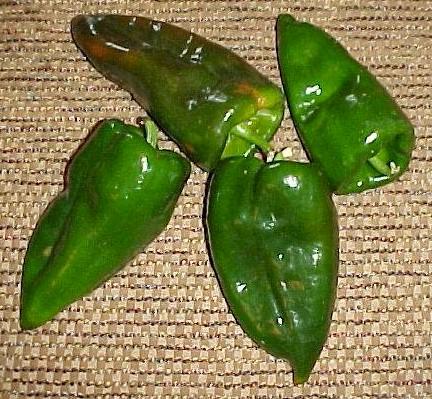
I found some great poblano chiles at the Marion Square market over the weekend, and this is the dish I concocted to use them. I happened to have some leftover barbecued chicken (hickory smoked on the grill the night before) and corn, so that's what I used for the filling. But, you could substitute all kinds of ingredients and make an equally great meal. Here's my version, which used four poblanos (enough to serve two people):
First, make the batter, since it needs to chill in the refrigerator for 30 minutes or so before using. Mix 3/4 cup flour with 1/2 tsp baking powder and a pinch of salt, then pour in half a bottle of beer (the rest is for the chef) and stir until smooth. Refrigerate the batter while you do the rest.
The next step is to roast and peel the four poblano peppers. There are many ways to do this, but since I don't (alas) have a gas stove I use my oven's broiler. Place the peppers on a sheet of aluminum foil and put under the broiler. Broil them for a minute or two on each side until the skin is blistered, turning the peppers with tongs until they are roasted all over. Don't worry if the skin turns black in some places, as long as the pepper doesn't get totally charred. (Other ways to accomplish the blistering is to toast them marshmallow-style over a gas burner, toss them in a hot cast iron skillet, or roast them in a 375-degree oven.)
Once the skins are blackened and bubbly, wrap in damp paper towels and put in a plastic baggie (or, in a bowl covered with plastic wrap), and leave them there for 10 minutes or so. This steaming will make the skin easier to remove.
While the peppers are resting, mix up the filling. To follow my version, dice up a smoked chicken breast and mix it with about a 1/2 cup of corn kernels, 4 oz. of white cheese (white cheddar in my case, though queso blanco, Monterry Jack, or mozzarella would work, too), and 1/2 an onion diced small. (All sorts of ingredients would work well here--Ground beef, leftover beef, shrimp, rice, or blackbeans--though I would insist that there always be cheese in some form.)
To peel the peppers, make a long slit down the side, then pull out the seeds and other bits from the middle. The skin should be well bubbled away from the sides of the peppers by now, and you can just grab it with your fingers and peel it away. Stuff each pepper with the filling mixture, then close the opening with a toothpick or two.
To fry, heat a large pan over medium-high heat and, once hot, add enough olive oil to cover the bottom well. Roll each stuffed pepper in the batter until it is well coated, then place in the hot oil. Fry for a couple of minutes on each side until golden brown, then allow to drain on paper towels.
You could serve these in a zillion ways. I surrounded mine with shredded lettuce and diced tomato, put a dollop of sour cream on top, and served with lime wedges for squeezing over the top. I think it was the combination of the smoky chicken with the crisp batter, but they were even better than I expected, and a great summertime meal.
Wednesday, August 17, 2005
Atkins & the Potato Farmers
You may have heard that Atkins Nutritionals filed for bankruptcy, but who knew the potato farmers would be so happy about it?
Bad Kitchen Equipment

Most kitchen gadgets are just that: gadgets. They're trivial little gewgaws that promise to do something special or trim a corner or just make your life easier in some way. They're usually highly specialized, like a melon baller or an olive pitter or a garlic peeler. In the end, most aren't terribly useful and don't do anything that you couldn't accomplish with basic tools such as a knife and spoon. But they are fairly harmless, since they don't actively hinder your efforts to do something in the kitchen. They just get pushed to the back of the drawer where they quietly gather dust.
Then there is bad kitchen equipment. These are varieties of common kitchen tools that perform (or, at least, are supposed to perform) a standard function in the kitchen. And they do it so poorly that they actually hamper your work and make the cooking process unpleasant. Unlike gadgets, these are core tools that you must use again and again or shell out money replace them with proper versions.
Most bad kitchen equipment, I am convinced, is designed by and for people who don't cook. There can be no other explanation for how supposedly-useful things could be designed so poorly. Take glass cutting boards, for example. I can see their appeal: they seem so sanitary. Glass isn't easily stained, and even the stickiest food can be scrubbed right off. And, since they are clear, you can tell when you've gotten every last shred of crud off of them, and once washed they are gleaming and spotless. It's the perfect thing for a world that is panicked about bacteria and the "hidden killers in the kitchen".
There's only one problem: chopping anything on a glass cutting board is an excruciating, ear-grating, mind-maddening nightmare. Unlike wooden or synthetic boards, glass does not give at all under a knife, so the blade just tick-tick-ticks along the surface with a sound not unlike nails on a chalkboard. Glass boards are slick, too, so vegetables tend to slide around like crazy and you're always one slip away from a serious laceration.
There seems to be some debate over the relative merits of wooden vs. plastic in terms of bacterial safety, but glass rarely enters into the discussion--if only, perhaps, because even an aesthetics-free organization like the Food and Drug Administration could not make a straightfaced recommendation that a cook use glass instead of wood or plastic.
I can go either way on plastic vs. wood. Personally, I prefer a good heavy wooden cutting board for aesthetic reasons: it just feels nicer to me when chopping, and I hate the way a plastic board gets scarred up with repeated use. But I can see why people would prefer plastic, particularly since you can just throw it in the dishwasher and not worry about ruining it. But, I see no way that anyone who actually cooks (that is, anyone who needs to dice a carrot or slice an onion every once in a while) could stand to use a glass cutting board.
Yet I seem to come across them all the time--at friends' house, relatives' houses, and especially in rented beach houses. They are passable if you need to, for example, cut a lime into eighths for a margartia or Corona bottle (explaining perhaps their presence in rented beach houses), but anything beyond five or six knife strokes sends me into a fit (and my wife, too, who is by now thoroughly sick of hearing me complain about glass cutting boards at rented beach houses).
I think the health issue factors into it: glass seems cleaner, so many people buy that. Also, it seems that if you want to buy decorative cutting boards then glass is the way to go. You can get all sorts of glass boards painted with scenes of homey looking fruit and cheese displays--perfect for a house that probably rarely if ever sees fresh fruit or actual wheels of cheese because, after all, where would you cut them? Not on that glass cutting board. It would drive you mental.
Subscribe to:
Posts (Atom)
Popular Posts
-
 I'm on the hunt for bacon. Specifically, for places in Charleston serving bacon in interesting or innovative ways, for a feature I'...
 -
 The latest episode of the Winnow is now out, and in Episode #7 Hanna and I talk dining institutions of all sorts: cookbooks by big-name...
 -
In which depending upon the kind assistance of strangers produces a curious recipe. [This is part three of a series on the Roffinac. St...
